
Why Hydraulic Hoses Fail — Causes and Prevention
HIGH WEAR RESISTANT · 415 bar working / 1660 bar burst · 4.6–10.1 mm
↓Certifications & factory photos
- Published Range
- Nominal bore:4.6–10.1 mm
- Max working pressure:415 bar
- Min burst pressure:1660 bar
- Mass per metre:0.33–0.6 kg/m.
- Size range:4 codes in the table, from 2SN-03-05 upward
- Hose Features
- Bend Radius:The published codes route down to 90–130 mm minimum radius.
- Compared on Real Data:The comparison below uses the dimensional figures our own lines produce, not marketing shorthand.
- Narrowed to One Answer:The point of a guide is to end with a single recommendation for your duty.
- Standards Explained:Where two standard designations look similar, we say which property actually separates them.
- Application:Almost every hose failure has an identifiable cause, and most of them are decided before the hose is ever fitted.
24 Hours Service Hotline
+86 137 2136 0724


For distributors, OEMs & MRO buyers · 30+ countries · MOQ 100 m · free samples
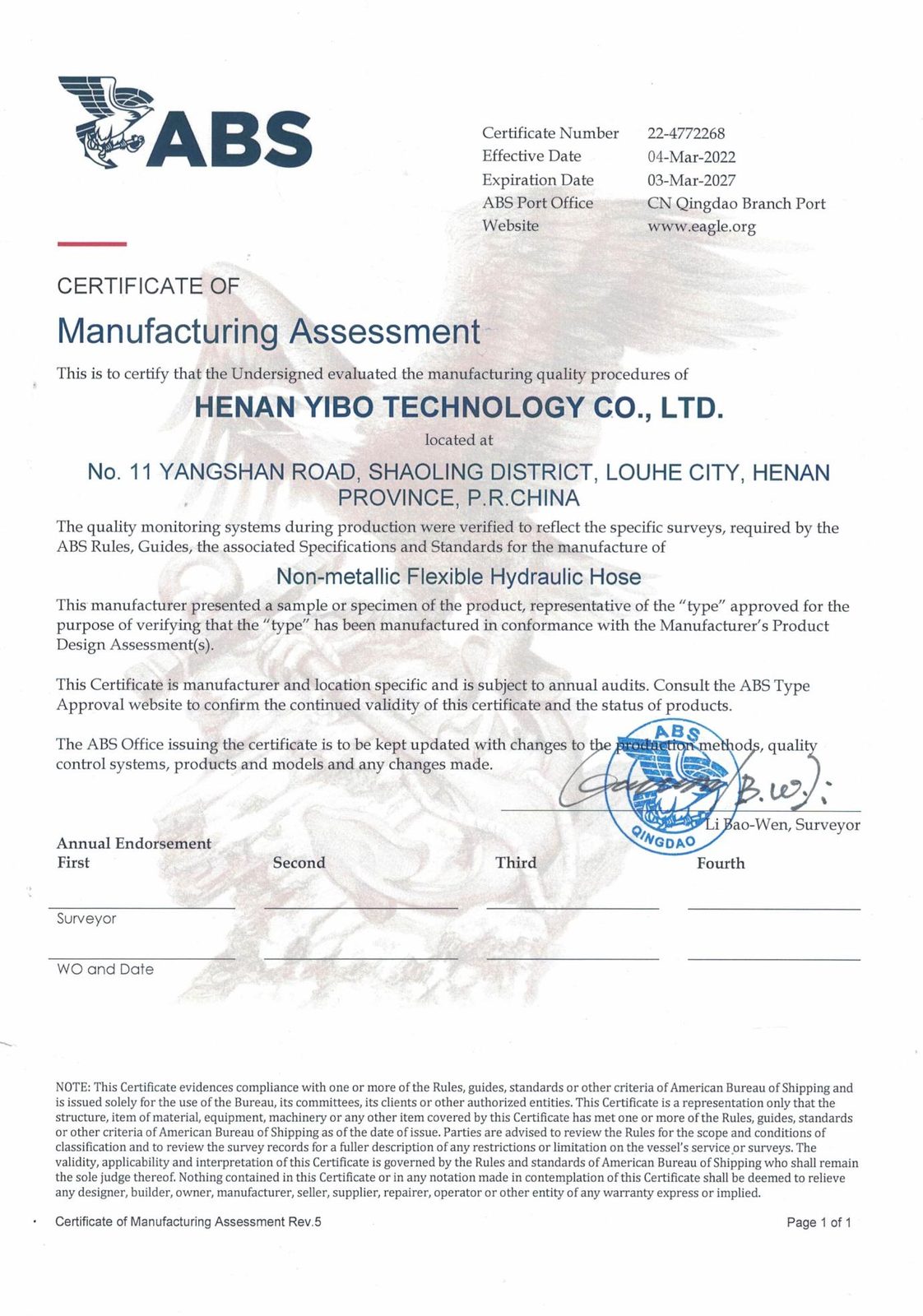
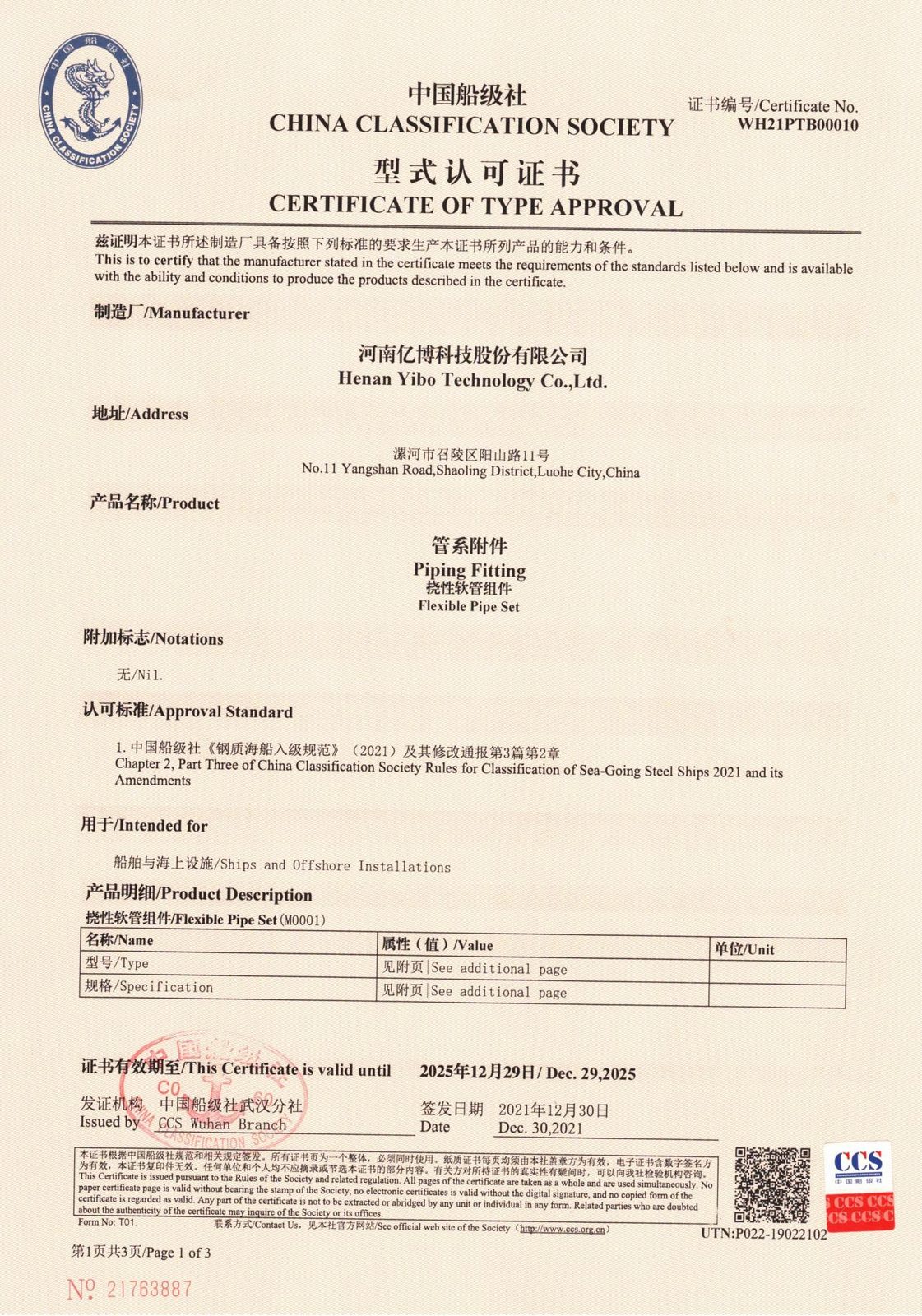
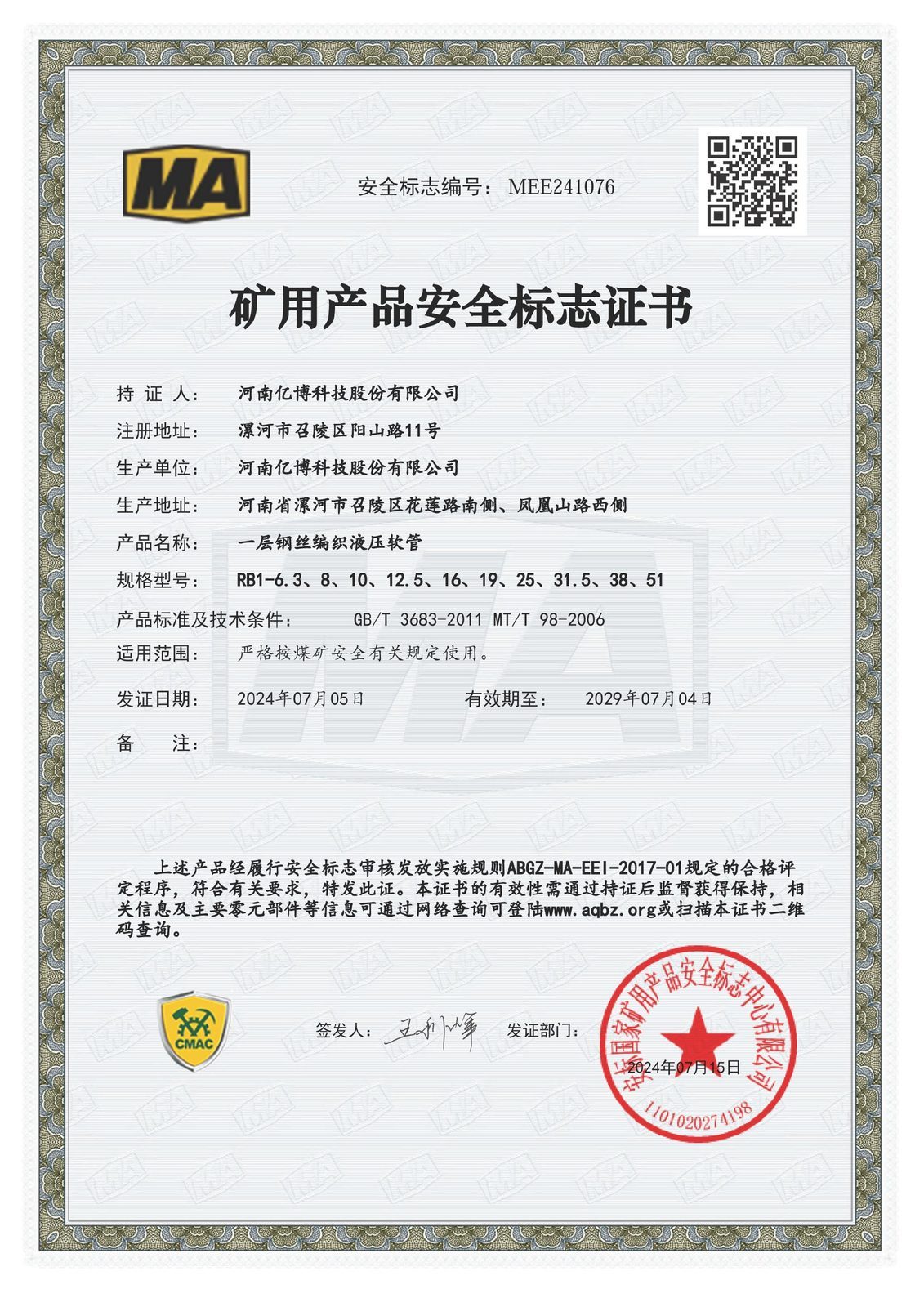


In stock — ready to ship sooner than custom runs. Ask which sizes →
PRODUCT INTRODUCTION
Why Hydraulic Hoses Fail — and What the Burst Margin Proves
Start with the margin. A 2SN hose at 3/16 inch is rated 41.5 MPa (415 bar) working, with 1,660 bar minimum burst. That is four times its rating. A hose cannot burst at 415 bar unless something has already reduced it.
This is the single most useful fact in failure investigation: the burst figure is the evidence. When a hose fails at or near working pressure, the cause is one of four things. It was bent tighter than its minimum arc, which is 90 mm at the 3/16 code and 130 mm at 3/8. Its ferrule did not cover the full braid. Its wire corroded under a broken cover. Or the circuit spiked above the rating.
The rest of this page works from the symptom back to the cause, because the symptom is what a maintenance team sees and the cause is what has to change.
Data Display
Almost every hose failure has an identifiable cause, and most of them are decided before the hose is ever fitted.
| PRODUCT NAME | NOMINAL INNER DIAMETER (mm) | SPECIFICATION (inch) | INNER DIAMETER (ID)mm (min) | INNER DIAMETER (ID)mm (max) | REINFORCEMENT LAYER OUTER DIAMETER (W.D)mm (min) | REINFORCEMENT LAYER OUTER DIAMETER (W.D)mm (max) | OUTER DIAMETER (OD)mm (max) | MAXIMUM WORKING PRESSURE W.P (Mpa) | psi | MINIMUM BURST PRESSURE B.P (Mpa) | psi | MINIMUM BENDING RADIUS Min.B.R (mm) | REFERENCE WEIGHT W.T (Kg/m) |
|---|---|---|---|---|---|---|---|---|---|---|---|---|---|
| 2SN-03-05 | 5 | 3/16“ | 4.6 | 5.4 | 10.6 | 11.7 | 16 | 41.5 | 6,019 | 165.0 | 24,076 | 90.0 | 0.31 |
| 2SN-04-06 | 6.3 | 1/4” | 6.2 | 7.0 | 12.1 | 13.3 | 17.7 | 40.0 | 5,802 | 160.0 | 23,206 | 100.0 | 0.35 |
| 2SN-05-08 | 8 | 5/16“ | 7.7 | 8.5 | 13.7 | 14.9 | 19.4 | 35.0 | 5,076 | 140.0 | 20,305 | 115.0 | 0.4 |
| 2SN-06-10 | 10 | 3/8” | 9.3 | 10.1 | 16.1 | 17.3 | 21.7 | 33.0 | 4,786 | 132.0 | 19,145 | 130.0 | 0.49 |
Values are reproduced from the official YIBO product page. Why Hydraulic Hoses Fail — Causes and Prevention: psi columns = MPa × 145.038, rounded. Why Hydraulic Hoses Fail — Causes and Prevention: Across the 4 codes the top rating is 415 bar working / 1,660 bar minimum burst; the order data sheet governs the batch.
Application & Selection
Almost every hose failure has an identifiable cause, and most of them are decided before the hose is ever fitted. Why Hydraulic Hoses Fail — Causes and Prevention covers 4.6–10.1 mm across 4 published codes.
Why Hydraulic Hoses Fail — Causes and Prevention tops out at 415 bar working over its 4 codes. Why Hydraulic Hoses Fail — Causes and Prevention: Plan the supports around 0.33–0.6 kg/m per metre. Why Hydraulic Hoses Fail — Causes and Prevention assemblies ship crimped and pressure-tested, with metric / BSP / JIC / ORFS ends. Allow about 20 days from confirmation for Why Hydraulic Hoses Fail — Causes and Prevention; OEM marking and packing on request.
WHY THIS HOSE
Four Causes, in Order of Frequency
Field failures cluster. These four account for most of them, and each leaves a different signature on the hose.
Bent Tighter Than the Arc
The 3/16 code needs 90 mm and the 3/8 code 130 mm. A kink ovalises the bore, the wire takes a permanent set, and the failure appears at the kink rather than mid-run.
Ferrule Not Covering the Braid
The braid runs 10.6 to 17.3 mm on this range. If the ferrule skirt stops short of it, the wire pulls back under pressure and the hose separates at the coupling, not at the body.
Corrosion Under a Broken Cover
Once the cover is cut, moisture reaches the wire and the burst figure falls away while the working pressure still looks fine on paper. This is the quiet failure.
A Spike Above the Rating
Water hammer and dead-heading produce pressures well above the pump setting. The 4:1 margin absorbs a lot, but it is finite: 1,660 bar on the 3/16 code.
Heat Cycling the Cover
Repeated thermal cycling hardens the cover until it cracks, which is the entry point for moisture and the start of the third cause.
Abrasion Exposing Wire
External abrasion on a moving arm wears through the cover long before the reinforcement is affected, and the damage is visible from outside.
CONSTRUCTION
Which Layer Fails, and What It Tells You
Inner Tube
Bored 4.6 mm to 10.1 mm. A tube failure shows as a blister or a weep without external damage, usually from an incompatible medium rather than pressure.
Reinforcement
Two wire braids, 10.6 to 17.3 mm. Wire failure is where the burst figure lives: corroded or fatigued wire gives a ragged split along the axis, not a clean hole.
Cover
Abrasion-resistant rubber, 16 to 21.7 mm outside diameter. A cracked or cut cover is not itself a failure, but it is the precondition for the wire failure that follows.
APPLICATIONS
Where Each Failure Mode Shows Up
Mobile Booms
Flexing at 130 mm or tighter on the 3/8 code produces fatigue breaks just behind the ferrule.
Engine Compartments
Heat cycling cracks the cover first, and the 17.7 mm outside diameter of the -04 code is often routed hard against a hot surface.
Mining and Quarry
Abrasion through the cover is the leading cause, because rock dust wears rubber faster than it wears wire.
Pilot Circuits
A 90 mm arc at the 3/16 code is easy to violate during a field repair, and the resulting kink fails within weeks.
Cold Stores
Repeated freeze cycles embrittle the cover, and the crack opens at the flex point.
Service Trucks
Improperly crimped replacements are a common cause, because the ferrule has to match the 21.7 mm body at 3/8 inch.
HIGH-END INDUSTRY DIRECTIONS
Why Failure Analysis Is Being Asked For
Buyers increasingly send a failed hose back rather than simply reordering, because the cost of repeat failure is higher than the cost of the part.
① Repeat Failure Cost hose reliability
Trend: A second failure on the same machine is treated as an engineering issue.
Dohose: We ask for the failed section and the route, not just the part number.
② Burst Data on Certificates traceable hose
Trend: Maintenance teams want the burst figure to compare against the failure.
Dohose: Burst is printed per row, 166.0 MPa on the 3/16 code.
③ Cover as a Wear Item abrasion resistant hose
Trend: Sleeving and rerouting are now scheduled, not reactive.
Dohose: Cover compound and outside diameter are stated so sleeving can be sized.
④ Crimp Records crimped hose
Trend: Crimp diameter is logged so a pull-off can be traced to a batch.
Dohose: Crimp diameter and proof pressure are recorded per assembly.
⑤ Route Audits hose routing
Trend: Fleets audit bend radius against the specification rather than by eye.
Dohose: Minimum arc is published bore by bore, 90 mm to 130 mm.
⑥ Spike Measurement high pressure hose
Trend: Pressure logging is being used to find spikes the gauge never showed.
Dohose: Working and burst are quoted together so the margin can be judged.
WHY DOHOSE
Seven Reasons Buyers Stay with Us
Numbers, Not Averages
Every figure for the Why Hydraulic Hoses Fail — Causes and Prevention comes from the per-code table: 4.6–10.1 mm, 415 bar working, 1660 bar burst.
One Line, Full Range
All 4 codes of the Why Hydraulic Hoses Fail — Causes and Prevention come off the same line, so a mixed order in 4.6–10.1 mm ships together.
Length on Demand
Cut-to-length supply for Why Hydraulic Hoses Fail — Causes and Prevention; each code carries its own mass, 0.33–0.6 kg/m, so lifting gear can be sized first.
Ends Done Here
Assemblies of Why Hydraulic Hoses Fail — Causes and Prevention are crimped on site and held at test pressure before they are boxed.
Export Packing
Coiled in poly bags, then woven bags on pallets — loading plans are drawn for 4-code orders.
OEM Ready
Brand printing and custom packing are standard options on the Why Hydraulic Hoses Fail — Causes and Prevention.
Fast, Firm Pricing
A firm price for Why Hydraulic Hoses Fail — Causes and Prevention usually returns within 1 hour of your enquiry.
FAQ
Hose Failure — Ten Diagnostic Questions
What is the difference between a weep and a burst?
A weep is a tube or pinhole leak that releases pressure slowly; a burst is a structural failure of the reinforcement. On this range the body is rated 41.5 MPa (415 bar) with 1,660 bar minimum burst, so a burst at working pressure means the wire was already degraded or the pressure was far above the rating.
Is a pinhole the same as a fatigue failure?
No. A pinhole usually starts at the tube, from an incompatible medium or a manufacturing fault, and shows as a fine jet with the cover intact. Fatigue failure starts in the wire, near the ferrule, and ends in a ragged split. The 4.6 to 5.4 mm bore of the 3/16 code makes a pinhole show up as a fast pressure drop.
What bend radius prevents a kink?
90 mm at the 3/16 code, 100 mm at 1/4 inch, 115 mm at 5/16 and 130 mm at 3/8. These are minimums for a static route; on a flexing arm the working arc should be larger, because a hose held at exactly its minimum will ovalise on the first pressure cycle.
At what pressure does a 2SN hose actually burst?
For the 3/16 code, 1,660 bar (24,076 psi) minimum, against 415 bar working. At 1/4 inch it is 160.0 MPa against 40.0 MPa, and at 3/8 inch 132.0 MPa against 33.0 MPa. Every row keeps a 4:1 ratio, so the burst figure scales with the rating rather than sitting at a fixed value.
Why do hoses fail at the ferrule more often than mid-length?
Because the crimp is where the reinforcement stops being continuous and where flexing concentrates. The braid measures 10.6 to 17.3 mm on this range, and if the ferrule does not grip the full layer the wire draws back under pressure, so the assembly separates well below the 1,660 bar the body can hold.
Why does the cover crack before the wire fails?
Because rubber ages faster than steel under heat and ozone. The cover on the -04 code sits at 17.7 mm outside diameter and is often routed against a hot surface, so it hardens and cracks, water enters, and the wire begins to corrode while the hose still holds pressure in test.
Why does a kink turn into a burst weeks later?
A kink at less than the 90 mm minimum permanently deforms the wire and ovalises the bore, so every subsequent pressure cycle loads the same few strands. The hose passes a static test and fails under cycling, which is why a kinked hose is scrapped rather than straightened.
How do I tell abrasion damage from fatigue damage?
Abrasion wears the cover from outside in, so the damage is visible and localised, with the braid exposed at 16 to 21.7 mm outside diameter where the cover has gone. Fatigue shows no external wear at all: the cover is intact and the failure is a split along the axis near the coupling.
Do you supply replacement assemblies to match a failed hose?
Yes, and we ask for the failed section plus the route, because the arc is usually the cause rather than the hose. Assemblies are crimped to a recorded diameter and proof-tested, in sizes from 4.6 mm to 10.1 mm inside diameter, with metric, BSP, JIC or ORFS ends.
What does a replacement cost, and can I get a sample to inspect?
Price follows the size: 0.33 kg/m at the 3/16 code to 0.6 kg/m at 3/8. Samples are cut free from the production run so a route can be checked against the 90 to 130 mm arc before the order is placed, and a firm figure follows bore, length, ends and destination.
Related Products
Automotive Power Steering HOSE
THE HOSE CONSISTS OF A HEAT-RESISTANT OIL SYNTHETIC RUBBER, ONE OR TWO LAYERS OF STEEL WIRE BR…
Compact Pilot HOSE
INNER TUBE: OIL-RESISTANT SYNTHETIC RUBBER. REINFORCEMENT: ONE LAYER OF STEEL WIRE BRAIDING. O…
Compact Single WIRE Braid Hydraulic HOSE
The hose consists of an inner tube, a single wire braid reinforcement, and an outer cover.
Compact Two-wire Braided Hydraulic HOSE
The hose consists of an inner tube, a double wire braid reinforcement, and an outer cover.
Get a quote
Please fill out the form below and we will contact you within 1 hour.
We are online 24/7!
We will contact you within 1 hour of receiving your enquiry.
Hotline