
Hydraulic Hose for Wind Turbines
FACTORY DIRECT · ISO 9001 · OEM AVAILABLE · 250 bar working / 1000 bar burst · 4 sizes
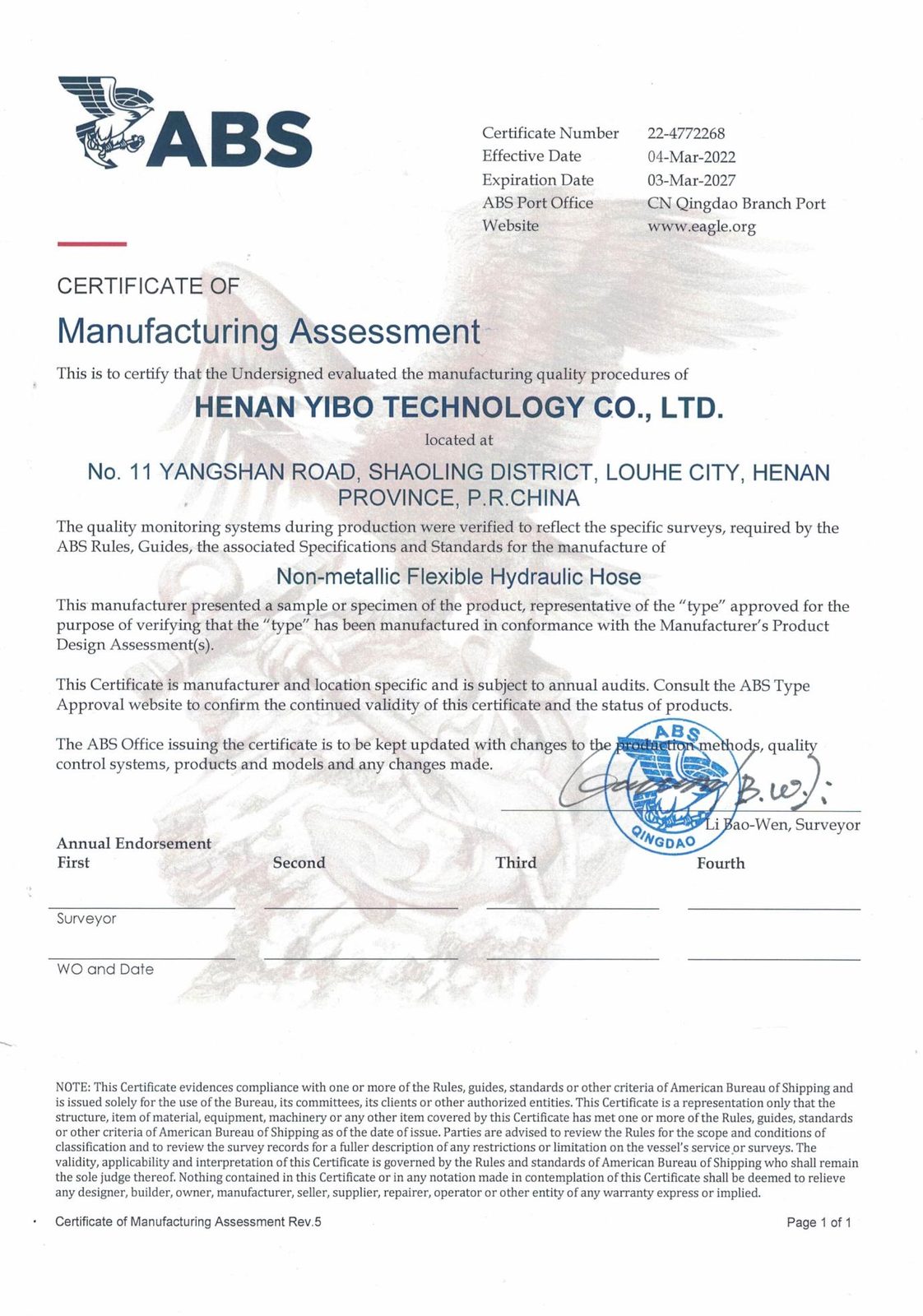
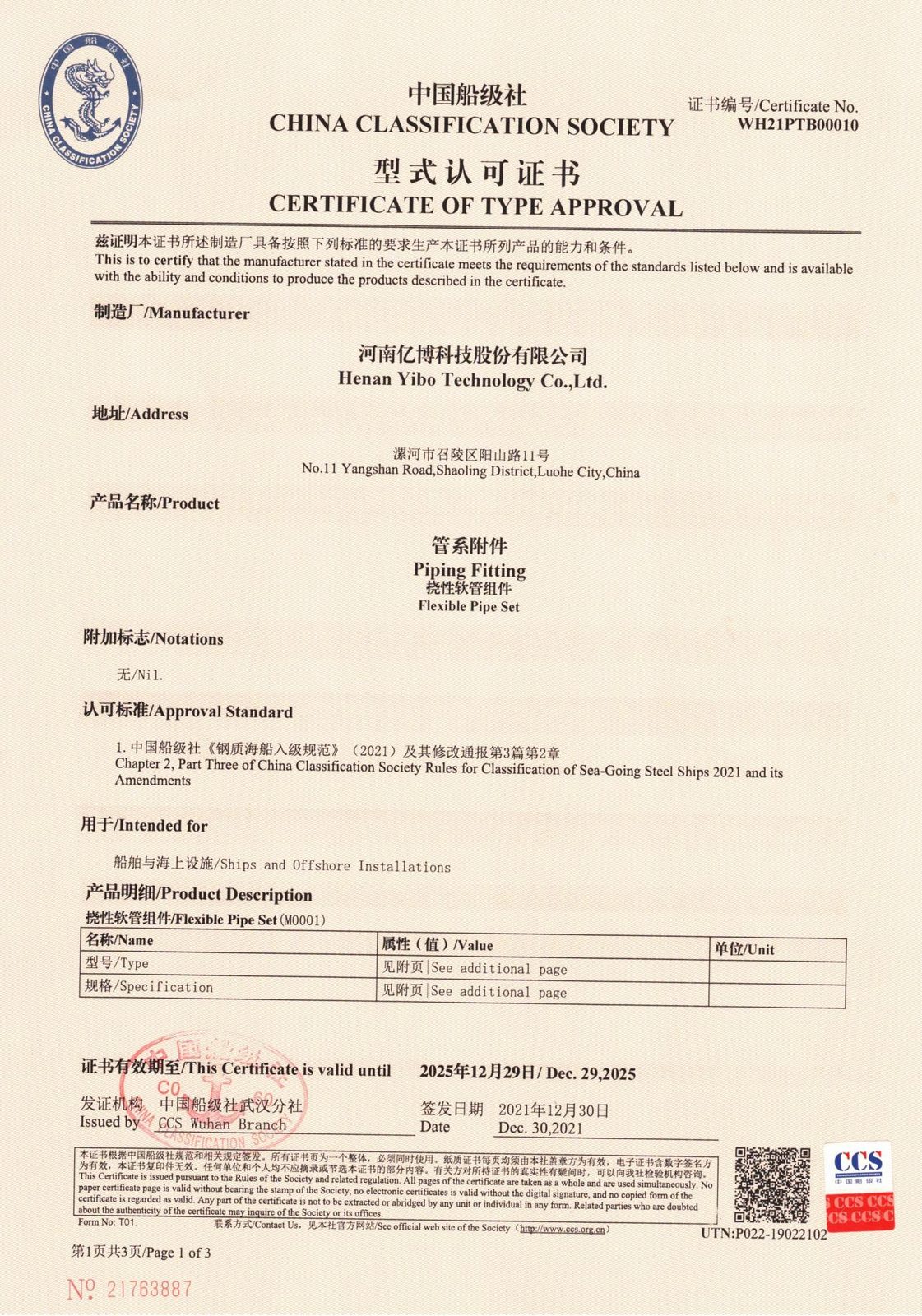
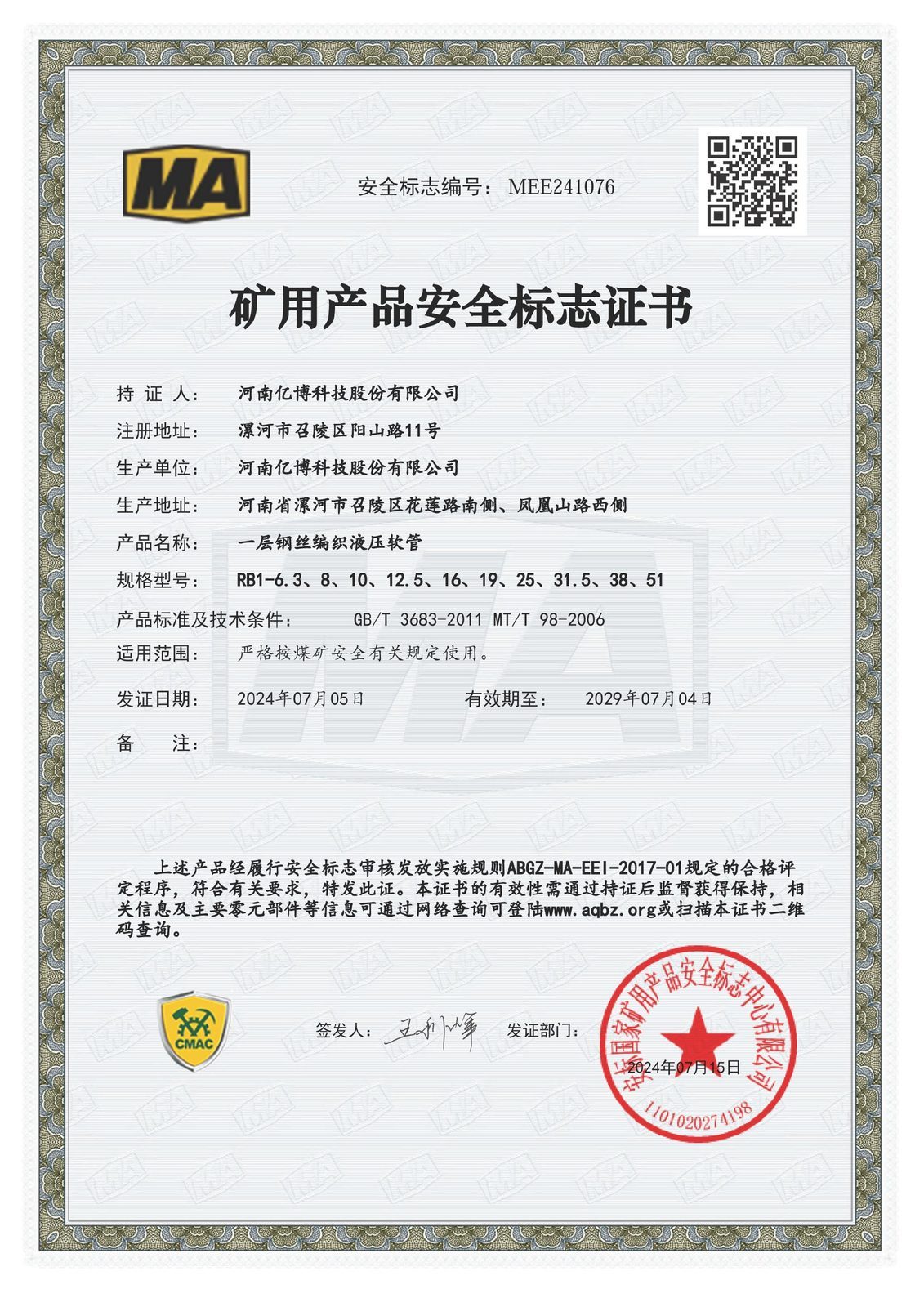
↓Certifications & factory photos
- Published Range
- Max working pressure:250 bar
- Min burst pressure:1000 bar
- Mass per metre:0.19–0.34 kg/m
- Nominal bore:5–10 mm across 4 published codes
- Hose Features
- Bend Radius:The published codes route down to 90–130 mm minimum radius.
- Duty-Cycle Matched:The construction is chosen against how hard the machine actually works, not against a catalogue default.
- Failure Mode First:We start from what normally fails on this equipment, then specify the hose that resists it.
- Tested Under Pressure:Working and burst pressure are verified in our own laboratory before shipment.
- Application:A turbine hydraulic system sits in a nacelle that is cold, high and hard to reach.
24 Hours Service Hotline
+86 137 2136 0724


For distributors, OEMs & MRO buyers · 30+ countries · MOQ 100 m · free samples


In stock — ready to ship sooner than custom runs. Ask which sizes →
PRODUCT INTRODUCTION
Wind Turbine Hydraulic Hose — Small Bore, Cold Climate, Long Service
A wind turbine is serviced twice a year at best, in weather nobody chooses. Its hydraulics are small bore — pitch, yaw brake and rotor lock — running at modest pressure but at temperatures that drop below -40 ℃ in the nacelle.
This page carries our cold-compounded single-braid range: 4 codes from 5 mm to 10 mm, rated 25.0 MPa (250 bar) at 5 mm down to 18.0 MPa (180 bar) at 10 mm, with a 4.0x burst margin. Mass runs 0.19 to 0.34 kg/m.
The compound is the point. These are the same pressure columns as our standard single-braid hose at these bores, but both rubber layers are compounded for low temperature, which is what a nacelle in February actually needs.
Data Display
A turbine hydraulic system sits in a nacelle that is cold, high and hard to reach.
| PRODUCT NAME | NOMINAL BORE (mm) | SPECIFICATION (inch) | INSIDE DIAMETER (ID)mm (min) | INSIDE DIAMETER (ID)mm (max) | OUTER DIAMETER OF REINFORCEMENT LAYER (W.D)mm (min) | OUTER DIAMETER OF REINFORCEMENT LAYER (W.D)mm (max) | OUTSIDE DIAMETER (OD)mm (max) | MAXIMUM WORKING PRESSURE W.P (Mpa) | psi | MINIMUM BURST PRESSURE B.P (Mpa) | psi | MINIMUM BEND RADIUS Min.B.R (mm) | REFERENCE WEIGHT W.T (Kg/m) |
|---|---|---|---|---|---|---|---|---|---|---|---|---|---|
| D1SN-03-05 | 5 | 3/16“ | 4.6 | 5.4 | 9.0 | 10.0 | 12.5 | 25.0 | 3,626 | 100.0 | 14,504 | 90.0 | 0.19 |
| D1SN-04-06 | 6.3 | 1/4” | 6.2 | 7.0 | 10.6 | 11.7 | 14.1 | 22.5 | 3,263 | 90.0 | 13,053 | 100.0 | 0.22 |
| D1SN-05-08 | 8 | 5/16“ | 7.7 | 8.5 | 12.1 | 13.3 | 15.7 | 21.5 | 3,118 | 86.0 | 12,328 | 115.0 | 0.27 |
| D1SN-06-10 | 10 | 3/8” | 9.5 | 10.1 | 14.5 | 15.7 | 18.1 | 18.0 | 2,611 | 72.0 | 10,443 | 128.0 | 0.34 |
Values are reproduced from the official YIBO product page. psi columns = MPa × 145.038, rounded. Bore 5–10 mm over 4 codes; each row carries its own rating, and the order data sheet governs the batch.
Application & Selection
A turbine hydraulic system sits in a nacelle that is cold, high and hard to reach. Hydraulic Hose for Wind Turbines is published in 4 codes spanning 5–10 mm bore. The 4 codes bend to a 90 to 130 mm minimum radius, so the line routes through the cramped nacelle and holds up through yaw without kinking.
Across the 4 codes of Hydraulic Hose for Wind Turbines the top figure is 250 bar working against 1,000 bar minimum burst — 4:1. From 0.19 to 0.34 kg/m over the 4 rows. We crimp and test every build in-house — 4 codes, 5–10 mm. Hydraulic Hose for Wind Turbines runs roughly 20 days from confirmation over its 4 codes, with OEM marking and packing.
WHY THIS HOSE
Six Reasons Turbine Hydraulics Need a Different Hose
Pressure is the easy part on a turbine. Cold, access and service interval are the hard ones.
Cold-Compounded Tube and Cover
Both rubber layers are built for low-temperature service, so the hose stays flexible when the nacelle is at ambient. A standard hose hardens and kinks at the bend.
250 bar at 5 mm Bore
The smallest code is rated 25.0 MPa (250 bar) with 100.0 MPa (1,000 bar) minimum burst, which covers pitch and yaw brake circuits with room.
90 mm Bend at 5 mm
Published per row and rising to 130 mm at 10 mm. Inside a nacelle the routing is fixed by the casting, so the bend radius decides the installation.
0.19 kg/m at the Lightest
Four codes weigh 0.19 to 0.34 kg/m, which is what a technician carrying a service kit up a tower wants.
Four Codes Cover the Circuits
5 mm to 10 mm covers pitch, yaw brake, rotor lock and the small utility lines in one range.
Crimped and Proof-Tested
Assemblies are crimped and tested before they leave the plant, because a return visit to a nacelle costs more than the hose.
CONSTRUCTION
Cold Compound, One Braid
Inner Tube
Synthetic rubber compounded for low temperature, bored 4.6 to 5.4 mm at 5 mm through to 9.5 to 10.1 mm at 10 mm.
Reinforcement
A single layer of steel wire braid, giving 25.0 MPa at 5 mm and 18.0 MPa at 10 mm with a 4.0x burst margin.
Cover
A cover compounded for the same cold window, outside diameter 12.5 mm at 5 mm and 18.1 mm at 10 mm.
APPLICATIONS
Where These Codes Sit in a Turbine
Pitch System
Pitch cylinder and accumulator lines at 5 and 6.3 mm, where 25.0 and 22.5 MPa cover the circuit and 90 to 100 mm fits the hub casting.
Yaw Brake
Yaw brake release and clamp lines at 8 mm, rated 21.5 MPa with a 110 mm bend radius.
Rotor Lock
Rotor lock cylinder lines at 10 mm, where 18.0 MPa is the working figure.
Hydraulic Power Unit
HPU outlet and return lines inside the nacelle, at 5 mm and 0.19 kg/m.
Service & Test Points
Gauge and test connections where a short, flexible whip is easier than a fixed line.
Cold-Climate Sites
Northern European, Nordic and high-altitude wind farms, where the ambient is the specification.
HIGH-END INDUSTRY DIRECTIONS
What Turbine Builders Ask For
Service interval drives everything: a hose that lasts to the next scheduled visit is worth more than one that is cheaper.
① Fewer Site Visits reliable hose
Trend: Offshore and remote turbines are serviced on a fixed calendar, so a hose must last the interval.
Dohose: Cold-compounded tube and cover, with every assembly proof-tested before it ships.
② Cold Nacelles low temperature hose
Trend: Nacelle temperatures sit far below ground level in winter.
Dohose: Both rubber layers are compounded for low-temperature service rather than one.
③ Small Bore, Fixed Castings compact hose
Trend: Hub and nacelle castings are designed before the hydraulic line.
Dohose: Bend radius runs 90 mm at 5 mm bore to 130 mm at 10 mm.
④ Technician Load lightweight hose
Trend: Everything goes up a ladder or a lift, so weight is a handling item.
Dohose: 0.19 kg/m at 5 mm through to 0.34 kg/m at 10 mm.
⑤ Pressure Held Steady standard hose
Trend: Pitch and yaw circuits are set once and rarely changed.
Dohose: One class per bore, 25.0 MPa at 5 mm down to 18.0 MPa at 10 mm, all with a 4.0x margin.
⑥ Traceability traceable hose
Trend: Component records follow the turbine serial number.
Dohose: Batch and test date are marked and recorded against the order.
WHY DOHOSE
Seven Reasons Buyers Stay with Us
Numbers, Not Averages
Every figure for the Hydraulic Hose for Wind Turbines comes from the per-code table: 5–10 mm, 250 bar working, 1000 bar burst.
One Line, Full Range
All 4 codes of the Hydraulic Hose for Wind Turbines come off the same line, so a mixed order in 5–10 mm ships together.
Length on Demand
Cut-to-length supply for Hydraulic Hose for Wind Turbines; each code carries its own mass, 0.19–0.34 kg/m, so lifting gear can be sized first.
Ends Done Here
Assemblies of Hydraulic Hose for Wind Turbines are crimped on site and held at test pressure before they are boxed.
Export Packing
Coiled in poly bags, then woven bags on pallets — loading plans are drawn for 4-code orders.
OEM Ready
Brand printing and custom packing are standard options on the Hydraulic Hose for Wind Turbines.
Fast, Firm Pricing
A firm price for Hydraulic Hose for Wind Turbines usually returns within 1 hour of your enquiry.
FAQ
Wind Turbine Hose — Ten Questions
Why a cold-compounded hose rather than a standard one?
Because a nacelle is not a workshop. A standard hose at -30 ℃ stiffens, and a stiff hose at its minimum bend radius kinks instead of flexing. The pressure columns here are the same as a standard single-braid body at these bores — 25.0 MPa at 5 mm, 18.0 MPa at 10 mm — so the compound is the only thing being bought.
Cold-compounded single-braid vs a two-braid body for pitch?
Pitch circuits do not need two braids. At 6.3 mm this range is rated 22.5 MPa (225 bar) with a 100 mm bend and 0.22 kg/m, while a two-braid body on the same bore carries far more pressure at more weight and a wider bend. The nacelle penalises weight and radius, not pressure.
What is the working pressure at 5 mm?
The 5 mm code is rated 25.0 MPa (250 bar, 3,626 psi) with 100.0 MPa (1,000 bar) minimum burst. Minimum bend radius is 90 mm, mass is 0.19 kg/m, and the inside diameter is held between 4.6 and 5.4 mm.
What is the rating at 3/8 inch?
The 10 mm code is rated 18.0 MPa (180 bar, 2,611 psi) with 72.0 MPa (720 bar) burst. Bend radius is 130 mm, mass is 0.34 kg/m, and the outside diameter is 18.1 mm.
Pitch vs yaw brake — which codes?
Pitch on 5 and 6.3 mm at 25.0 and 22.5 MPa, and yaw brake on 8 mm at 21.5 MPa with a 110 mm bend. All three sit well inside the pressure rating; the routing in the hub casting is what chooses between them.
Can this hose be used on the rotor lock?
Yes, at the 10 mm code: 18.0 MPa (180 bar) with a 130 mm bend radius. A rotor lock is an intermittent circuit at low pressure, so the round-bore flexibility of the cold compound matters more than the rating.
Why does a turbine hose fail at the fitting?
Because the hose is installed once and then sits under pressure and vibration for months. On a 5 mm line rated 25.0 MPa the ferrule sees a steady load rather than a cycle, so a crimp that was marginal at installation creeps and weeps long before the tube fails. Assemblies are proof-tested here for that reason.
Why does the hose kink when it is cold?
Because a cold compound has less give at the same bend radius. At 5 mm the minimum is 90 mm and at 10 mm it is 130 mm; in a nacelle at -20 ℃ lay the line out above those figures, because the material will not absorb the difference the way it does on a bench.
Which Chinese manufacturer supplies wind turbine hose?
YIBO, in Luohe, Henan, supplies the cold-compounded single-braid range in 4 codes from 5 mm to 10 mm, all with a 4.0x burst margin, crimped and proof-tested in-house.
What does turbine hose cost per metre?
Price follows the body: 0.19 kg/m at 5 mm, 0.27 kg/m at 8 mm, 0.34 kg/m at 10 mm, so 100 m of the 5 mm code is a 19 kg coil. Send bore, length, ends and destination for a firm figure the same working day.
Related Products
Automotive Power Steering HOSE
THE HOSE CONSISTS OF A HEAT-RESISTANT OIL SYNTHETIC RUBBER, ONE OR TWO LAYERS OF STEEL WIRE BR…
Compact Pilot HOSE
INNER TUBE: OIL-RESISTANT SYNTHETIC RUBBER. REINFORCEMENT: ONE LAYER OF STEEL WIRE BRAIDING. O…
Compact Single WIRE Braid Hydraulic HOSE
The hose consists of an inner tube, a single wire braid reinforcement, and an outer cover.
Compact Two-wire Braided Hydraulic HOSE
The hose consists of an inner tube, a double wire braid reinforcement, and an outer cover.
Get a quote
Please fill out the form below and we will contact you within 1 hour.
We are online 24/7!
We will contact you within 1 hour of receiving your enquiry.
Hotline