
HOSE ASSEMBLY
CRIMPED & TESTED · 560 bar working / 2,240 bar burst
Reply within 1 hour · Built to drawing or sample · 100% tested · OEM marking
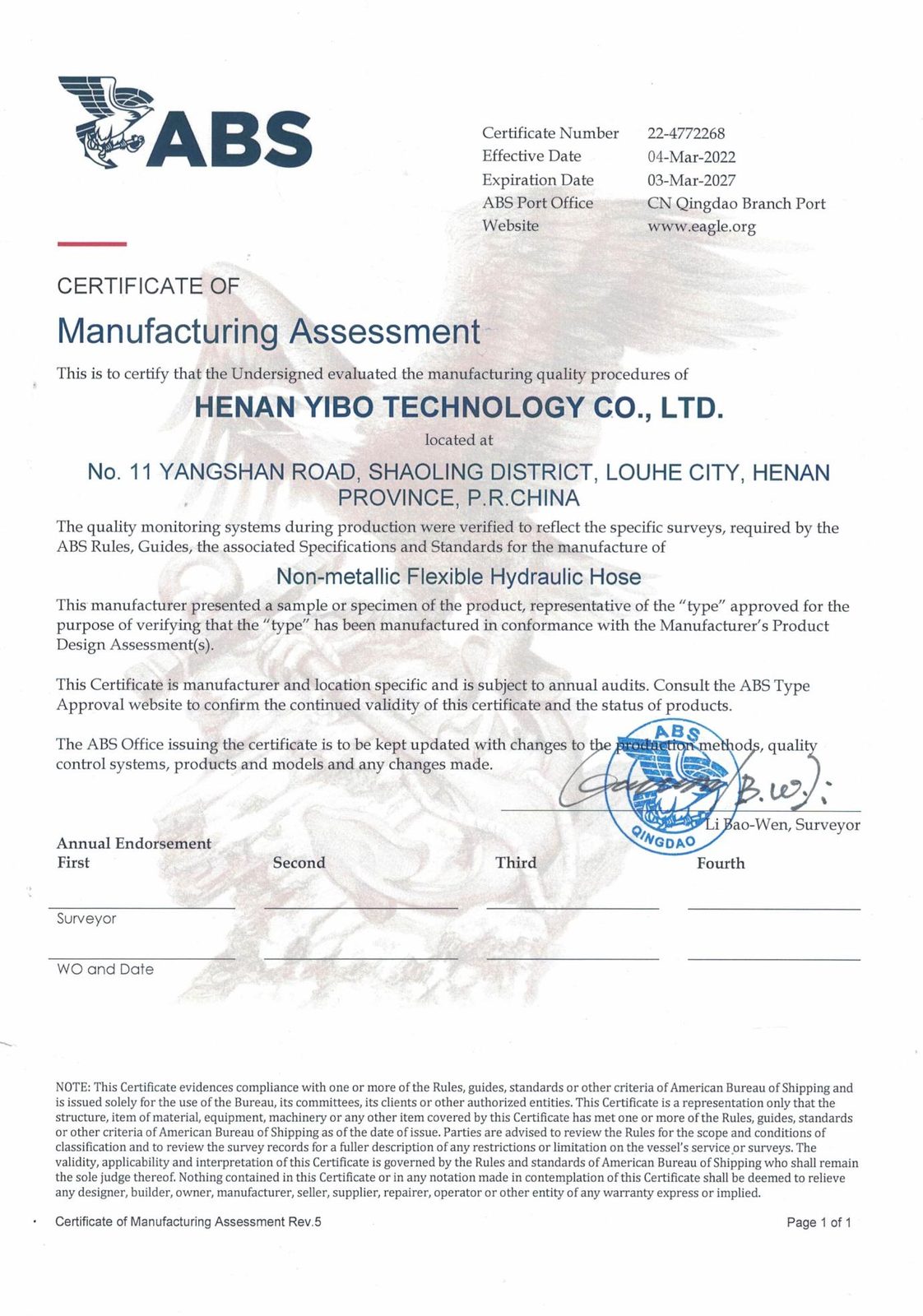
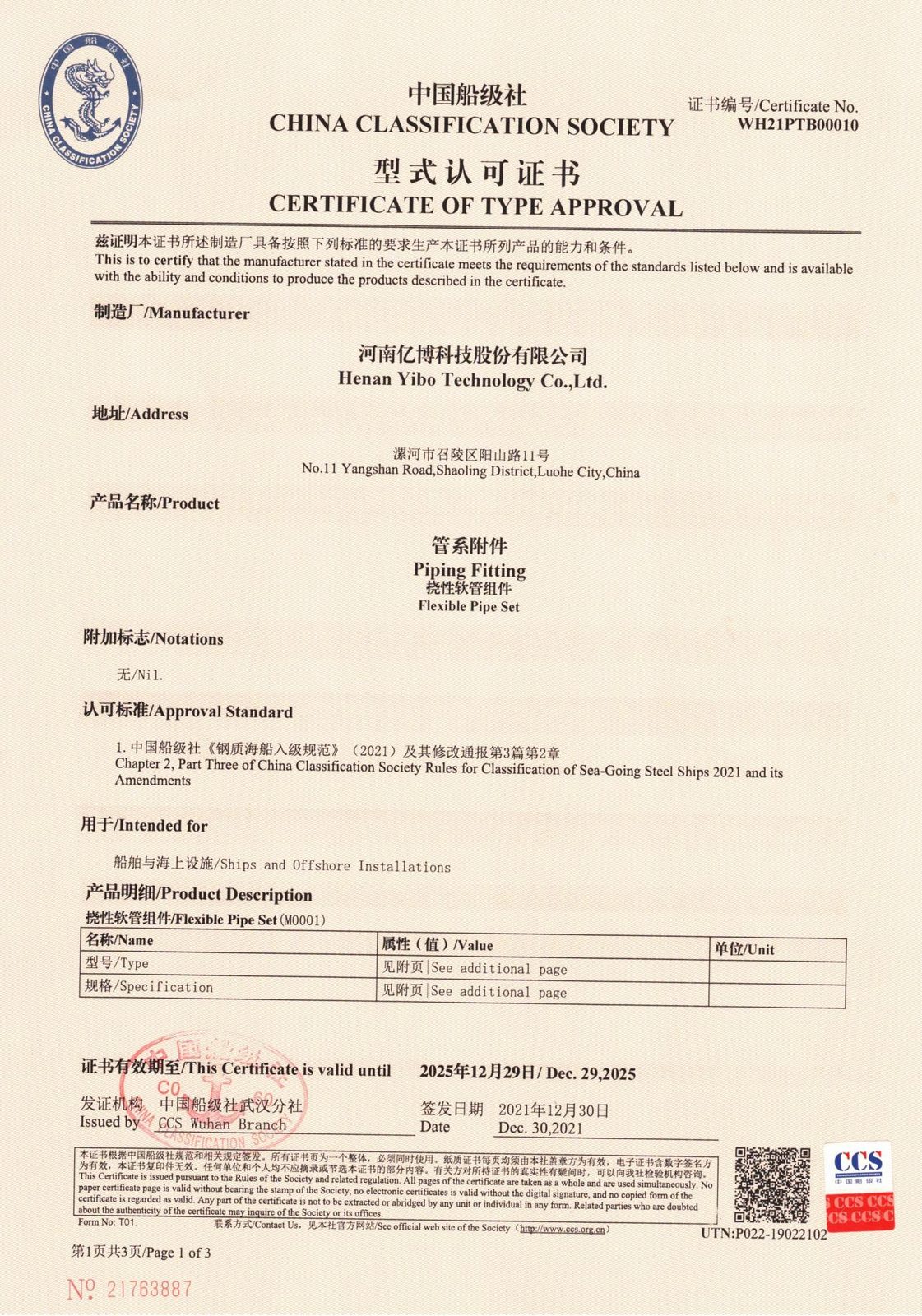
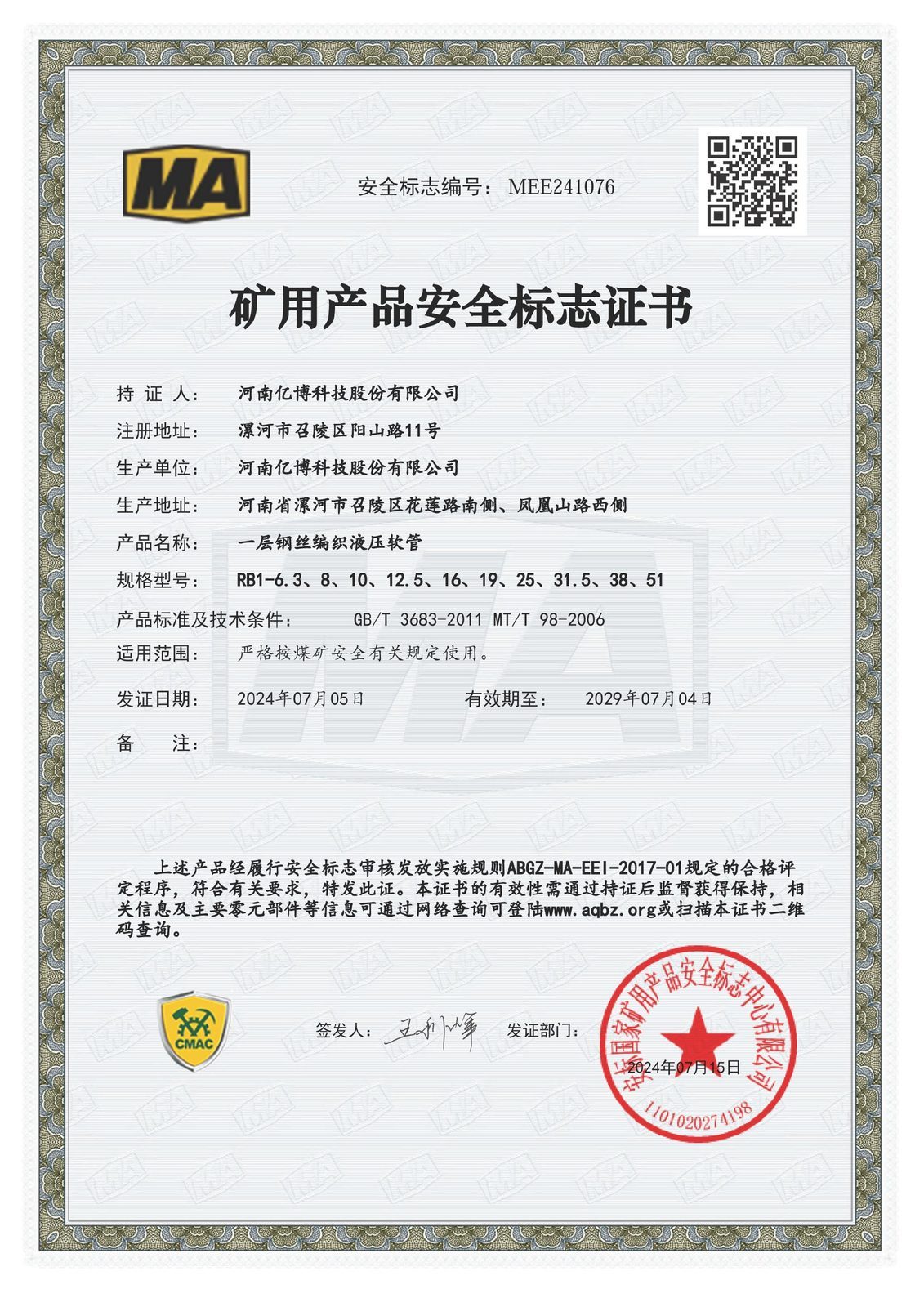
↓Certifications & factory photos
- Assembly Construction
- Structure:Hose body, fitting and crimped ferrule, CNC crimped and hydrostatically tested one by one
- Working Temperature:-40℃ to +100℃, per the hose body selected
- Assembly Features
- Pressure Rating:28–56 MPa (280–560 bar) working, minimum burst at 4× working pressure, quoted per code in the table
- Size Coverage:1/4"–1-1/4" (6–32 mm), 8 published codes
- End Connections:Metric, BSP, JIC and ORFS; SAE flanges on request
- Mass Per Metre:0.425–2.078 kg/m for the hose body
- Application:Construction machinery, mining supports, injection moulding machines and agricultural equipment
24 Hours Service Hotline
+86 137 2136 0724


For distributors, OEMs & MRO buyers · 30+ countries · MOQ 100 m · free samples


In stock — ready to ship sooner than custom runs. Ask which sizes →
PRODUCT INTRODUCTION
Hydraulic Hose Assemblies — 56 MPa at 1/4 inch, Crimped and Hydro-Tested
A YIBO assembly is a hose body, a fitting and a crimped ferrule, put together on a CNC crimper and hydrostatically tested one by one rather than sampled. The hose body is not the whole product; the crimp is.
The range is 8 codes from 1/4 inch to 1-1/4 inch, 6 mm to 32 mm. Working pressure is 56 MPa (560 bar) at the 1/4 inch code and 28 MPa (280 bar) from 3/4 inch upward, with minimum burst at 4x working pressure on every row.
Ends are metric, BSP, JIC and ORFS as standard, with SAE flanges on request. Minimum bend radius runs from 50 mm at 1/4 inch to 225 mm at 1-1/4 inch, and the hose body mass from 0.425 to 2.078 kg/m.
Hydraulic Hose Assembly Specification Table

| SPECIFICATION (inch) | HOSE INNER DIAMETER I.D. (mm) | HOSE OUTER DIAMETER O.D. (mm) | WORKING PRESSURE W.P (MPa) | W.P (psi) | BURST PRESSURE B.P. (MPa) | B.P. (psi) | MINIMUM BENDING RADIUS (mm) | WEIGHT (kg/m) |
|---|---|---|---|---|---|---|---|---|
| 1/4" | 6 | 15.4 | 56 | 8,122 | 224 | 32,489 | 50 | 0.425 |
| 5/16" | 8 | 17 | 50 | 7,252 | 200 | 29,008 | 55 | 0.486 |
| 3/8" | 10 | 19 | 42 | 6,092 | 168 | 24,366 | 73 | 0.559 |
| 1/2" | 13 | 22 | 35 | 5,076 | 140 | 20,305 | 100 | 0.627 |
| 5/8" | 16 | 25 | 32 | 4,641 | 128 | 18,564 | 117 | 0.804 |
| 3/4" | 19 | 28.6 | 28 | 4,061 | 112 | 16,244 | 144 | 0.955 |
| 1" | 25 | 35.7 | 28 | 4,061 | 112 | 16,244 | 190 | 1.448 |
| 1 1/4" | 32 | 44 | 28 | 4,061 | 112 | 16,244 | 225 | 2.078 |
Values are reproduced from the official YIBO product page. psi columns = MPa × 145.038, rounded. 560 bar working and 2,240 bar minimum burst is the ceiling of this range; the order data sheet for the selected hose body and fitting governs the batch.
Hydraulic Hose Assembly Application & Selection
Start with the circuit: working pressure, flow, oil temperature and routing space decide the hose body. Above roughly 40 MPa, or on circuits with heavy impulse, the body has to be multi-layer spiral — bore size alone is not a selection method.
Then the two ends: thread type (metric, BSP, JIC, ORFS), elbow angle and orientation. The fastest route is a drawing, a sample, or simply the machine model and the mounting position — we copy the original routing.
Finally length and marking: measured on the machine or taken from the drawing, with your part number and batch printed on the hose. Production runs about 20 days from confirmation.
WHY THIS HOSE
Six Reasons the Crimp Is the Product
Most hydraulic failures are assembly failures, not hose failures. These six points are about the joint rather than the rubber.
56 MPa at the 1/4 inch Code
The 6 mm assembly is rated 56 MPa (8,122 psi) with 224 MPa minimum burst. Small bore does not mean low pressure: it usually means the opposite.
Burst at Four Times Working
Every one of the 8 codes carries minimum burst at 4x its working pressure, from 224 MPa at 1/4 inch down to 112 MPa at 1-1/4 inch.
Tested One by One
Assemblies are hydrostatically tested individually, not by sample. A crimp that looks right and seals wrong is the failure mode this removes.
Bend Radius From 50 mm
50 mm at 1/4 inch through to 225 mm at 1-1/4 inch, published per row, because the bend at the ferrule is where most short-life failures start.
Four End Families
Metric, BSP, JIC and ORFS are standard, with SAE flanges on request, so a machine with mixed ports does not need two suppliers.
Marked and Traceable
Batch and test date go on the assembly, so a claim can be traced back to the coil and the crimp record rather than to a bin.
CONSTRUCTION
Body, Fitting, Ferrule
Hose Body
A hydraulic body sized per the table, from 6 mm to 32 mm bore. Working pressure is set by the body and read from the row, not from the fitting.
Fittings
Metric, BSP, JIC and ORFS as standard, SAE flanges on request, matched to the port rather than to what happens to be in the bin.
Ferrule
Crimped on a CNC machine to a recorded diameter for that body and fitting pair, then hydrostatically tested before the assembly is packed.
APPLICATIONS
Where These Assemblies Go
Construction Machinery
Excavator, loader and backhoe lines, usually 1/2 inch at 35 MPa with a 100 mm bend radius.
Mining Support Systems
Shield and advance circuits on longwall equipment, where a failed assembly stops a face rather than a machine.
Injection Moulding Machines
Clamp and injection lines at 3/4 inch and 28 MPa, with a 144 mm bend radius inside the frame.
Agricultural Equipment
Tractor and implement circuits, where mixed port standards make a four-family fitting range necessary.
OEM Build
Fitted on the production line to the machine drawing, with the assembly marked and tested before it reaches the station.
Export Spare Kits
Kitted, labelled and packed for overseas dealers, with the part number on the bag rather than in a list.
HIGH-END INDUSTRY DIRECTIONS
Where Assembly Demand Is Going
Buyers are moving from coils and site crimping to finished, tested assemblies, which is the main change in this category.
① Assemblies, Not Coils hose assembly
Trend: Machine builders increasingly buy the finished line rather than a coil plus a site crimp.
Dohose: Every assembly is crimped on a CNC machine and hydro-tested individually before packing.
② Pressure at Small Bores high pressure hose
Trend: Compact circuits push pressure up at small bores rather than adding size.
Dohose: The 1/4 inch code is rated 56 MPa, the highest row in the table.
③ Tighter Routing compact hose
Trend: Frame envelopes shrink and the bend at the ferrule becomes the design constraint.
Dohose: Minimum bend radius is published from 50 mm at 1/4 inch to 225 mm at 1-1/4 inch.
④ Mixed Port Standards hose assembly
Trend: Machines assembled for export mix metric, BSP, JIC and ORFS ports on the same unit.
Dohose: All four families are standard, with SAE flanges on request.
⑤ Contamination Control clean hydraulic hose
Trend: Proportional valves specify cleanliness at the port, so a dirty assembly is a warranty claim.
Dohose: Bores are blown through and capped before crimping.
⑥ Traceability traceable hose
Trend: Warranty terms ask which batch and which crimp record a failed assembly came from.
Dohose: Batch and test date are marked on the assembly and recorded per order.
WHY DOHOSE
Seven Reasons Buyers Stay with Us
Published Per Code
The Hose Assembly is published code by code — 8 rows, 6–32 mm, each with its own pressure and mass.
One Factory, Whole Range
From the smallest to the largest bore in 6–32 mm, the Hose Assembly is made in one plant — no second source.
Cut to the Metre
Take the length the job needs — Hose Assembly is cut from the coil, with 0.425–2.078 kg/m for the hose body published so handling can be planned.
Tested Before Boxing
Every assembly built from Hose Assembly passes a hydrostatic test before it leaves the plant.
Packed for the Container
Pallet layouts for Hose Assembly are planned against the container, so freight per metre stays predictable.
Private Label
Printing, labels and packing for Hose Assembly can carry a distributor brand.
Same-Hour Reply
Bore, quantity and ends are enough to price Hose Assembly; the reply goes out within 1 hour.
FAQ
Hose Assembly — Ten Questions From Machine Builders
Crimped assembly vs reusable field-fit fittings?
A crimped assembly is rated by the table: 56 MPa at 1/4 inch, 28 MPa at 3/4 inch and above, burst at 4x working. A reusable fitting depends on how well it was assembled on site, which is exactly the variable a warranty cannot absorb. For anything above 200 bar we quote crimped, tested assemblies.
JIC vs ORFS for a 420 bar line?
Both are available, and the pressure is carried by the body rather than the thread: at 3/8 inch the assembly is rated 42 MPa (420 bar) with 168 MPa burst, whichever end family you choose. The choice is usually made by the port on the machine and by whether the joint has to be re-made in the field.
What is the pressure rating and bend radius at 3/8 inch?
The 10 mm assembly is rated 42 MPa working (6,092 psi) with 168 MPa (24,366 psi) minimum burst. Minimum bend radius is 73 mm and the hose body is 0.559 kg/m. A 3/8 inch line bent tighter than 73 mm at the ferrule is the most common short-life failure we see.
What is the bend radius of a 1 inch assembly?
The 25 mm assembly has a 190 mm minimum bend radius, rated 28 MPa (280 bar) with 112 MPa burst, and the hose body is 1.448 kg/m. At that weight a long 1 inch run needs support, because an unsupported drop pulls on the crimp.
Which assembly for an excavator hose kit?
1/2 inch is the usual size for a kit: 35 MPa (350 bar) working, 140 MPa burst, a 100 mm bend radius and 0.627 kg/m. Mixed port standards on older machines are why the fitting range covers metric, BSP, JIC and ORFS rather than one family.
Which assembly for an injection moulding machine?
3/4 inch at 28 MPa (280 bar) with a 144 mm bend radius fits most clamp and injection frames, and 0.955 kg/m keeps the line manageable at the manifold. Where the frame is tighter, 5/8 inch at 32 MPa buys back 27 mm of bend radius.
Why do my assemblies leak at the swivel?
Almost always a crimp that sealed at test and relaxed in service, or a fitting mated to the wrong seat. A crimped assembly is tested individually before it ships, so a leak in the first week points at the port or the torque rather than the crimp, especially on a 3/4 inch joint rated 28 MPa. Send the end type and the port it went into.
Why did a new assembly fail within a week?
Check the bend before the hose. At 3/8 inch the minimum radius is 73 mm and at 1/2 inch it is 100 mm; an assembly forced into a routing tighter than that works the wire at the ferrule on every pressure cycle and fails early. Twisting the hose during installation instead of holding the fitting costs life the same way.
Can you build to drawing, and what is the minimum order per part number?
Yes. Send the drawing or the port list and the assembly is built to it: 8 codes from 1/4 inch to 1-1/4 inch, 6 mm to 32 mm, with metric, BSP, JIC and ORFS ends and SAE flanges on request. Minimum quantity follows the part number rather than the order, so a kit of different lengths is quoted as a set.
What is the lead time and price for 50 assemblies?
Price follows bore, ends and length: 0.425 kg/m at 1/4 inch, 0.955 kg/m at 3/4 inch, 2.078 kg/m at 1-1/4 inch. Fifty assemblies of the same part number is a single crimp run rather than fifty separate jobs, which is where the price comes down. Send the drawing, quantity and destination for a firm figure.
Related Products


Get a quote
Please fill out the form below and we will contact you within 1 hour.
We are online 24/7!
We will contact you within 1 hour of receiving your enquiry.
Hotline