Henan Yibo Technology Co., Ltd. Hydraulic hose OEMcreate value for customers
Industrial Hose Solutions · Based on Published Product Data

Industrial hose for liquid cooling,
chemical transfer and compact lines

YIBO builds on six existing industrial hose lines and a hydraulic hose range to supply equipment builders, system integrators and industrial distributors. Hose and crimped assemblies are selected against the medium, pressure, temperature, end fitting and available space.

Every figure on this page comes from an existing specification table. Capabilities we cannot verify are not claimed, and the selection boundaries are stated separately.

Data Center Liquid CoolingChemical & Process FluidsCompact & Dynamic LinesCrimped Assemblies
Scope: the liquid cooling hose is specified for industrial and data centre cooling loops. This page does not cover food, beverage or potable water duty requiring food-grade certification.
6Industrial hose lines
6–203 mmIndustrial bore range
10–20 barIndustrial working pressure
3:1–4:1Burst margin by line
100 mCut-to-length MOQ
1 hourEnquiry response

For equipment builders, system integrators and industrial distributors  ·  cut-to-length & crimped assemblies  ·  MOQ 100 m  ·  quote within 1 hour

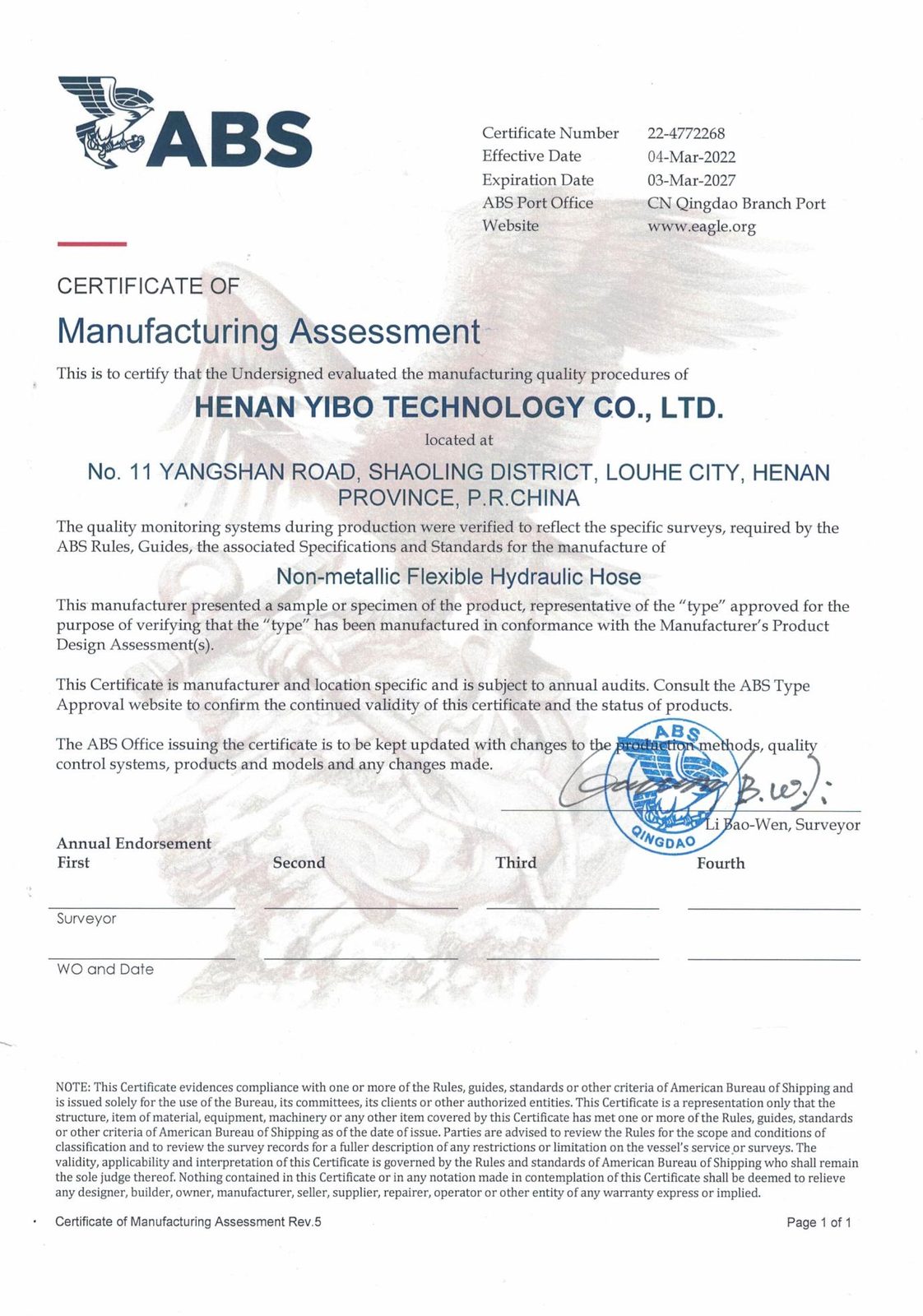
ABS American Bureau of Shipping certificate
ABSAmerican Bureau of Shipping
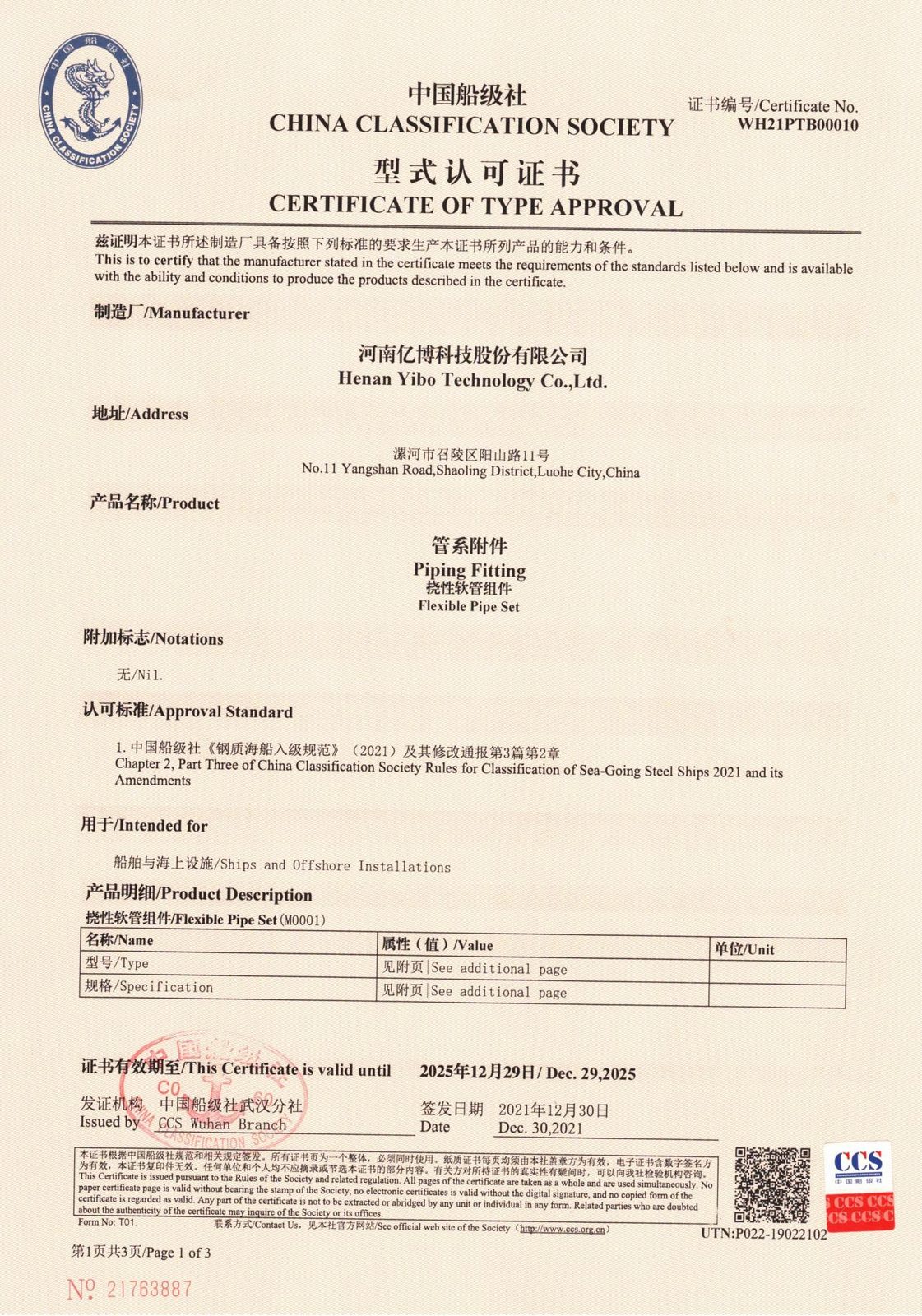
CCS China Classification Society certificate
CCSChina Classification Society
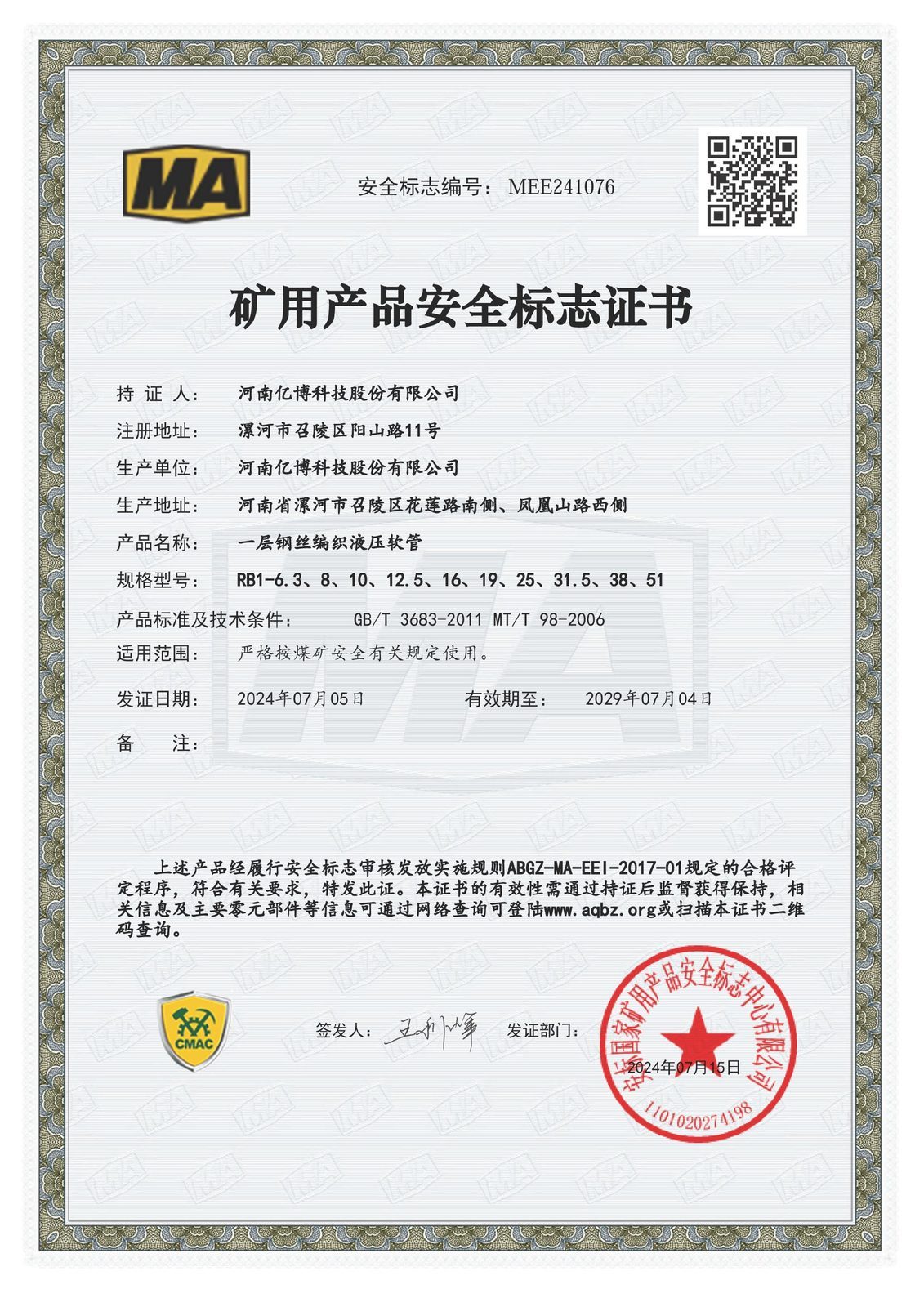
China mine product safety mark certificate
Mine Safety MarkChina MA certification
China invention patent certificate
Invention Patent70+ patents held
Steel wire braiding workshop
Steel wire braidingbraiding line
In-house rubber testing laboratory
In-house labfactory testing
Rubber extrusion line
Rubber extrusionhose build line

Credentials note: the certificates and photographs above are the company's existing records. The product categories and standards each certificate covers are those stated in the certificate itself. Whether the industrial hose products on this page fall within that scope must be confirmed with us for the specific model; nothing here should be read as a type approval for them.

Three application areas mapped to product lines we already build

This is not a new product roadmap. It is our existing range reorganised around how the equipment uses it: each area names the matching series and its published figures, and states which properties must still be confirmed against the real duty.

01 / THERMAL MANAGEMENT

Data centre liquid cooling hose

Matches our Data Center Liquid Cooling Hose (205): EPDM tube and cover with one or two layers of synthetic fibre braid, and a cover specified for weather, abrasion and ozone resistance plus V0 flame retardancy. Used for flexible connections from CDU to rack, rack manifold to server node, and within cold plate loops.

Published figures: 8 sizes from 1/4" to 1-1/4" (6.1–32.8 mm bore); 13.8 bar / 200 psi on the three small codes and 10 bar / 145 psi on the five larger; minimum bend radius 24.5–195 mm; mass 0.13–0.70 kg/m.
Selection boundary: coolant type, working pressure, temperature, flow, end fittings and installation space must be confirmed. Not for food-grade or potable water duty.
EPDMV0 coverCDUCold plateRack manifold
Full specification →
02 / CHEMICAL & PROCESS FLUIDS

Chemical and process fluid transfer hose

Matches our FEP Transfer Hose (247) and Conductive Chemical Transfer Hose (246). The FEP fluoroplastic liner handles strongly corrosive chemicals; the conductive UHMWPE+EPDM composite liner combines corrosion resistance with static dissipation for explosion-proof and anti-static pressure transfer.

Published figures: FEP range 19–102 mm, 10 bar working / 40 bar burst (4:1), −60 °C to +200 °C, standard 40 m. Conductive chemical range 19–102 mm, 10 bar / 30 bar burst (3:1), −35 °C to +100 °C, standard 40 m.
Selection boundary: we have no verifiable data for cleanliness class, extractables, particle control or semiconductor process certification. For precision temperature control, high-purity or semiconductor duty, material and product grade must be set by the actual medium, process conditions, customer specification and validation results.
FEP linerConductive UHMWPEAcids & alkalis40 m lengths
View FEP transfer hose →
03 / COMPACT & DYNAMIC LINES

Compact and dynamic connection lines

Matches our Compact Pilot Hose (171), Fibre-Reinforced Resin High-Pressure Hose (R7-166) and small-bore constant-pressure braided ranges. All share a small outside diameter, a tight bend radius and low mass per metre, which suits connections inside equipment and near moving assemblies.

Published figures: pilot hose, 4 codes 5–10 mm, 12.5 MPa working / 25 MPa burst, 9.5–15.8 mm outside diameter, 50 mm minimum bend radius, 0.40–0.55 kg/m. R7 resin hose, 4.6–25.4 mm bore, 21.0–22.5 MPa single layer and 10.5–27.4 MPa two layer, bend radius 35–256 mm.
Selection boundary: we have no test data for repeated bending, torsion or motion life. For robot joints, arms or any continuously moving part, the hose must be validated against the actual bend radius, cycle frequency, pressure and installation path.
Small ODTight bendLow massPilot controlResin hose
View compact pilot hose →

At the same bore, the three layers decide whether it can be used

The usual purchasing mistake is to pick on bore and pressure alone. What actually causes rework is a tube that is incompatible with the medium, a bend radius that does not fit, or a cover that cannot survive the site. Here is each layer, using only what is published for the three ranges.

Tube · in contact with the medium

EPDM on the liquid cooling range, for water and glycol coolant loops; FEP fluoroplastic or a conductive UHMWPE+EPDM composite liner on the chemical range, for strongly corrosive media and where static dissipation is required; the R7 range is a fibre-reinforced resin body with no rubber tube. If the tube is incompatible with the medium, no pressure rating will rescue the application.

Reinforcement · sets working pressure and bend radius

One or two layers of synthetic fibre braid on the liquid cooling range; reinforcement configured to the pressure class on the FEP and conductive chemical ranges; braided reinforcement on the pilot range, with a fibre-reinforced resin body carrying the load on R7. At the same bore, more layers carry more pressure, but outside diameter, mass per metre and minimum bend radius all grow with them — which is why the liquid cooling range runs from 24.5 mm at 1/4" to 195 mm at 1-1/4".

Cover · sets service life, carries no pressure

EPDM cover on the liquid cooling range, specified for weather, abrasion and ozone resistance plus V0 flame retardancy; cover compound and flame configuration on the other ranges are confirmed per model. The cover carries no pressure, yet it decides service life under UV, oil, abrasion and open flame — and it is the first layer to age on site.

Two more things must be fixed beyond the three layers

  • Ends and crimping: metric, BSP, JIC and ORFS ends, with assemblies crimped and pressure-tested in house. A wrong end fitting makes the best hose unusable.
  • Length and bend radius: industrial lines are normally 100 m cut to length, and the FEP and conductive chemical ranges are standard 40 m; bend radius covers 24.5–256 mm. Force a bend into too little space and the failure will sit at the crimp.
  • Temperature window: −60 °C to +200 °C on the FEP range, −35 °C to +100 °C on the conductive chemical range. Outside the window the tube hardens or softens and the pressure rating no longer holds.
Note: only published construction information is listed. Compound grades, layer counts and formulations that are not stated are not inferred here; they must be confirmed against the specific model datasheet and customer specification.
Compare the three specification tables →

Three specification tables, taken from existing product pages

Extracts only; each product page carries the full size list. Test conditions differ between ranges, so figures should not be compared across series.

Table 1 · Data centre liquid cooling hose (EPDM / synthetic fibre braid / V0 cover)
SizeBore mmOD mmWorking pressureBurst pressureMin bend radiusMass
1/4"6.1–7.211.6–12.61.38 MPa / 13.8 bar / 200 psi5.5 MPa / 55 bar / 798 psi24.5 mm0.13 kg/m
5/16"7.7–8.314.5–15.513.8 bar / 200 psi55 bar / 798 psi31.5 mm0.18 kg/m
3/8"9.5–10.315.4–16.413.8 bar / 200 psi55 bar / 798 psi37 mm0.19 kg/m
1/2"12.5–13.319.7–20.71 MPa / 10 bar / 145 psi40 bar / 580 psi *69 mm0.25 kg/m
5/8"15.8–16.622.5–23.710 bar / 145 psi40 bar / 580 psi *88 mm0.30 kg/m
3/4"18.8–19.626.4–27.610 bar / 145 psi40 bar / 580 psi *113 mm0.35 kg/m
1"25.2–26.233.6–34.810 bar / 145 psi40 bar / 580 psi *143 mm0.52 kg/m
1-1/4"31.8–32.843–44.610 bar / 145 psi40 bar / 580 psi *195 mm0.70 kg/m

* In the source table the five larger codes listed burst pressure equal to working pressure, which is physically impossible. They were corrected to a 4:1 ratio (4.0 MPa / 40 bar / 580 psi) and noted on the product page as factory-test confirmed. This page follows that corrected figure.

Table 2 · Chemical and process fluid transfer (extract)
Series / sizeBore mmOD mmWorking pressureBurst pressureTemperatureStandard length
FEP transfer 3/4"193210 bar / 145 psi40 bar / 580 psi−60 °C to +200 °C40 m
FEP transfer 2"5165.210 bar / 145 psi40 bar / 580 psi−60 °C to +200 °C40 m
FEP transfer 4"102120.410 bar / 145 psi40 bar / 580 psi−60 °C to +200 °C40 m
Conductive chemical 3/4"1931.210 bar / 145 psi30 bar / 435 psi−35 °C to +100 °C40 m
Conductive chemical 2"5164.610 bar / 145 psi30 bar / 435 psi−35 °C to +100 °C40 m
Conductive chemical 4"102117.410 bar / 145 psi30 bar / 435 psi−35 °C to +100 °C40 m
Table 3 · Compact and dynamic lines (extract)
Series / sizeBore mmOD mmWorking pressureBurst pressureMin bend radiusMass
Compact pilot 3/16"4.4–5.39.5–10.412.5 MPa / 125 bar25 MPa / 250 bar50 mm0.40 kg/m
Compact pilot 1/4"6.2–7.010.5–11.212.5 MPa / 125 bar25 MPa / 250 bar50 mm0.45 kg/m
Compact pilot 3/8"9.6–10.115.2–15.812.5 MPa / 125 bar25 MPa / 250 bar50 mm0.55 kg/m
R7 resin 3/16" single layer4.610.321.0 MPa84.0 MPa35 mm—
R7 resin 1/4" two layer6.113.327.4 MPa109.6 MPa75 mm—
R7 resin 1" two layer25.434.010.5 MPa42.0 MPa256 mm—

The R7 resin hose table lists the same part number in single-layer and two-layer builds with no layer column, so the layer must be stated on the order. No reference mass is published for that range.

Six connection points: from CDU to rack, from tank to machine tool

The tables above answer what sizes exist. This section answers where they go. All six points are covered by existing ranges, with the matching codes named. For robot joints, robot arms and other continuously moving parts we have no motion-life data — see selection boundaries.

205 / cooling

CDU to rack, main loop

The main circulation link between the cooling distribution unit and the rack. Bore follows flow, pressure class follows pump head. Typically 1/2" to 1-1/4": 10 bar working pressure, 69–195 mm minimum bend radius, 0.25–0.70 kg/m.

205 / cooling

Rack manifold to server node

Inside the rack the space is narrow and the route turns often, so 1/4" and 3/8" are more common: 24.5–37 mm bend radius and 0.13–0.19 kg/m, which routes more easily in a crowded enclosure.

205 / cooling

Cold plate loops and test benches

Short runs for single-server cold plate validation and bench testing. The three small codes run at 13.8 bar working and 55 bar burst, so a 4:1 margin is available for bench parts; a bench part is not automatically a production part.

247 / chemical

Chemical transfer, tank to line

Pressure transfer of strongly corrosive media. FEP fluoroplastic liner, 19–102 mm, 10 bar working / 40 bar burst, −60 °C to +200 °C, standard 40 m lengths to reduce intermediate joints.

246 / chemical

Solvent transfer in Ex and anti-static areas

Conductive UHMWPE+EPDM composite liner combining corrosion resistance with static dissipation. 10 bar working / 30 bar burst, −35 °C to +100 °C, for transfer duty where static build-up has to be suppressed.

171 + R7 / compact

Pilot control and high-pressure runs in tight space

Pilot and return circuits on machine tools, presses and construction equipment use 171: 9.5–15.8 mm OD, 50 mm bend radius, 12.5 MPa. High-pressure runs in confined space use R7: 4.6–25.4 mm, 21.0–27.4 MPa single layer.

One selection logic, shared by all three areas

The media and duty differ, but the sequence is the same: fix the tube against the medium, fix the reinforcement against the pressure class, then fix length, ends and validation. The six points below are why these figures are on the page — each one maps back to the tables in the previous section.

01

Pressure per code, never “up to”

The liquid cooling range states all 8 codes: 13.8 bar / 200 psi on the three small ones, 10 bar / 145 psi on the five larger. Quotations and drawings work per code rather than behind one headline maximum.

02

Burst margin, with its basis stated

55 bar (4:1) on the three small liquid cooling codes; 40 bar on the five larger, corrected to the same margin; 30 bar (3:1) on the conductive chemical range. Different ratios cannot be compared across ranges.

03

Bend radius per code

24.5–195 mm on the liquid cooling range, 50 mm on the pilot range, 35–256 mm on R7. Routing can be checked before the order, not on site after the hose refuses to bend.

04

Mass first, freight later

0.13–0.70 kg/m on the liquid cooling range and 0.40–0.55 kg/m on the pilot range. Total shipment weight can be estimated from length and bore, so sea freight sits in the landed cost at quotation stage.

05

Temperature windows kept apart

−60 °C to +200 °C on FEP, −35 °C to +100 °C on conductive chemical, and water or glycol coolant loops on the liquid cooling range. The three windows do not interchange; mixing them is over-temperature service.

06

Boundaries printed on the page

Food grade, semiconductor cleanliness and dynamic fatigue life are three requirements we have no verifiable data for, so they are not written as promises. Better to lose an enquiry than to ship a hose that will not fit or will not pass validation.

Four-step selection: ask in this order and rework drops

  • Step 1 · the medium: water or glycol, strong acid or alkali, solvent, or hydraulic oil? Are solids present, is static dissipation needed? If the tube is not settled, nothing after it matters.
  • Step 2 · pressure and bore: what is the working pressure, are there spikes? Derive the bore from flow, then look up the pressure for that code — not the other way round.
  • Step 3 · space and ends: available installation space, minimum bend radius, both end fittings, assembly length. Space is the item most often missed.
  • Step 4 · validation: applicable standard, customer specification, whether crimp and test records or batch traceability are needed. This decides whether test hours belong in the quotation.
Note: if any of the four is missing we come back with a question rather than a price — a quotation built on missing parameters is usually void by the sampling stage.

Support available to customers

  • Recommend an existing hose construction against medium, pressure, temperature and duty.
  • Set length and end type against the equipment interface and available space.
  • Select separately for static connections and for flexing applications.
  • Agree a sample test and validation plan against the customer specification.
  • Supply equipment builders, system integrators and industrial distributors.
  • Provide the datasheet and published figures for the named model, for design offices and buyers to compare.
Note: company credentials and the production site are shown under Factory & credentials; the scope each certificate covers is the one stated in the certificate.

What must be confirmed before an order

The items below are confirmed per order. We do not publish unverified claims, and stating them up front avoids a wrong selection and a rework later.

What this page does not claim

  • Food-grade or potable water duty: the liquid cooling and chemical transfer hoses are not offered for food, beverage or potable water applications requiring food-grade certification.
  • Semiconductor cleanliness: no claim is made for cleanliness class, low extractables, particle control or semiconductor process certification. Such requirements are governed by customer specification and test results.
  • Dynamic fatigue life: no claim is made for repeated bending or torsion cycles, or for a robot-joint service life. Moving applications must be validated against the real path, frequency and pressure.
  • Unverified factory capability: specific process parameters, capacity, certifications and special test conditions are confirmed per order and written into the technical agreement.
  • Cross-range interchangeability: the three areas differ in media compatibility, pressure class and validation, so one compound or construction cannot be assumed to serve all three.

What to send with an enquiry

  • Medium and concentration, and whether solids are present; working pressure and any spikes.
  • Continuous temperature range, and exposure to ozone, salt spray or flame requirements.
  • Required bore or flow, available installation space and minimum bend radius.
  • Both end fittings, assembly length, and whether crimp and pressure-test records are needed.
  • Applicable standards, customer specification and required validation items.

Frequently asked questions

Why does a data centre liquid cooling loop need its own hose selection instead of a general water hose?

Liquid cooling hose connects the CDU, the rack manifold and the server cold plate, so selection depends on coolant type, working pressure, temperature, flow, end fittings and available space. Our liquid cooling range is an EPDM tube and cover with synthetic fibre braid and a V0 flame-retardant cover, in 8 sizes from 6.1 to 32.8 mm bore, with minimum bend radius from 24.5 mm. A product name alone does not establish coolant compatibility.

Can you supply semiconductor-grade high-purity fluid hoses?

We have FEP-lined transfer hose and conductive UHMWPE+EPDM chemical transfer hose for pressure transfer of corrosive media. We do not have verifiable data for cleanliness class, extractables, particle control or semiconductor process certification, so suitability for high-purity or semiconductor duty must be determined by the actual medium, process conditions, customer specification and validation results. Nothing on this page should be read as a semiconductor-grade qualification.

Do you have hoses for robot joints or other continuously moving lines?

We have compact pilot hose, R7 resin high-pressure hose and small-bore constant-pressure braided hose with small outside diameters and tight bend radii, suited to connections inside equipment and confined spaces. We have no test data for repeated bending, torsion or motion life, so any continuously moving application must be validated against the actual path, cycle frequency, pressure and installation conditions before the hose is specified.

Can one hose be used across all three application areas?

No. The three areas differ in media compatibility, pressure class, temperature range and validation requirements. What they share is the selection method, the crimped assembly process and the test workflow; the tube compound and reinforcement must be determined separately for each duty.

What are the minimum order, supply length and end fitting options?

Our industrial hose lines are normally 100 m minimum, cut to length. The FEP and conductive chemical ranges are supplied in standard 40 m lengths. Ends cover metric, BSP, JIC and ORFS, and assemblies are crimped and pressure-tested in-house. The quotation and technical agreement govern the final terms.

Can the figures in these tables be used directly for design?

The figures are published specification values from the existing product pages and are suitable for preliminary selection. The burst pressure on the five larger liquid cooling codes was corrected from a source-table error to a 4:1 ratio and is confirmed by factory test. The R7 resin hose lists the same part number in single-layer and two-layer builds with no layer column, so the layer must be stated on the order. Final design must follow the specific model datasheet, customer specification and validation results.

Can you supply food-grade or potable water hose?

No. The liquid cooling and chemical transfer hoses on this page are not offered for food, beverage or potable water duty, and we do not hold FDA or EU 1935/2004 food-contact certification. If a project needs food-grade hose, raise it separately and we will answer honestly on whether the certification can be met — we will not make a verbal "food grade" claim.

How is this industrial hose different from 2SN hydraulic hose, and can they be interchanged?

No, they are different products. 2SN is an EN 853 steel wire braided hydraulic hose from 415 bar upward, for hydraulic oil, return and pilot circuits. The liquid cooling range on this page is an EPDM tube and cover with synthetic fibre braid at 10–13.8 bar, for coolant circulation. Pressure class, tube compound and cleanliness requirements all differ. The hydraulic range is at 2SN high-pressure steel wire braided hose.

How do OEM branding, cut-to-length and minimum order work?

OEM marking and cut-to-length crimping are available and confirmed per order. Industrial hose lines are normally 100 m minimum, cut to length, while the FEP and conductive chemical ranges are supplied in standard 40 m lengths. Ends cover metric, BSP, JIC and ORFS, and assemblies are crimped and pressure-tested in-house. The marking method, packaging and minimum batch are confirmed against the specific model.

How are samples and lead time arranged?

Sample scope, cost and lead time are confirmed per model and quantity; we do not publish one blanket figure. The usual sequence is to settle the model and construction against the duty, then arrange samples. Enquiries are answered within one hour, and the feasible sample and delivery dates are given in that reply.

Send us the duty and we will map it to an existing product line

Give us the medium and concentration, working pressure, temperature range, required bore or flow, available installation space, both end fittings and the validation items you need. We will reply with a feasible selection from the published tables and a list of anything that still needs confirming, within one hour of your enquiry.

Submit an Enquiry / Request a Quote

Available 24/7; we respond within 1 hour of receiving an enquiry.

Get a quote

Please fill out the form below and we will contact you within 1 hour.

*

Or email [email protected] · tel +86 137 2136 0724

We are online 24/7!

We will contact you within 1 hour of receiving your enquiry.

Factory direct · Henan Yibo Technology Co., Ltd. ISO 9001 quality system OEM / ODM available Reply within 1 hour