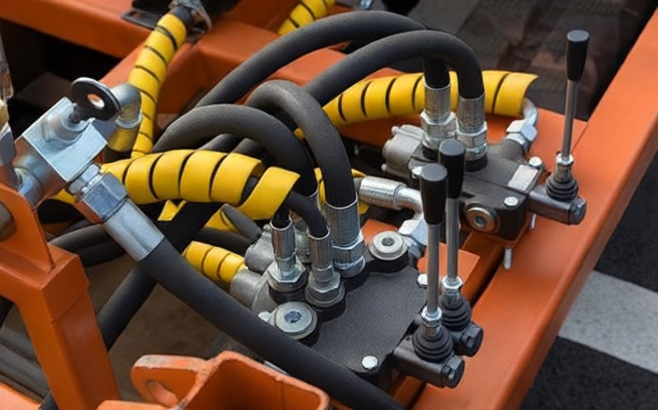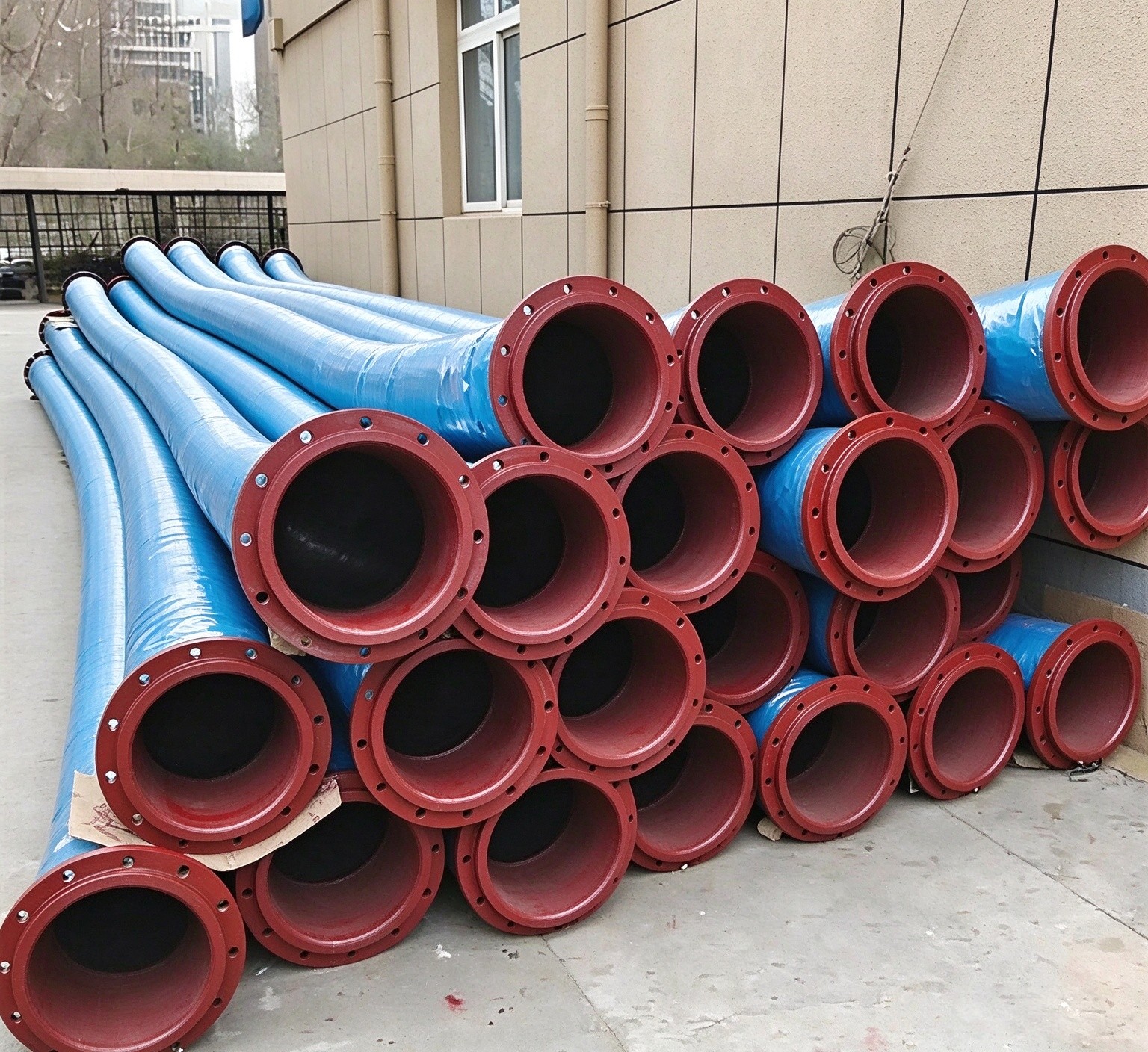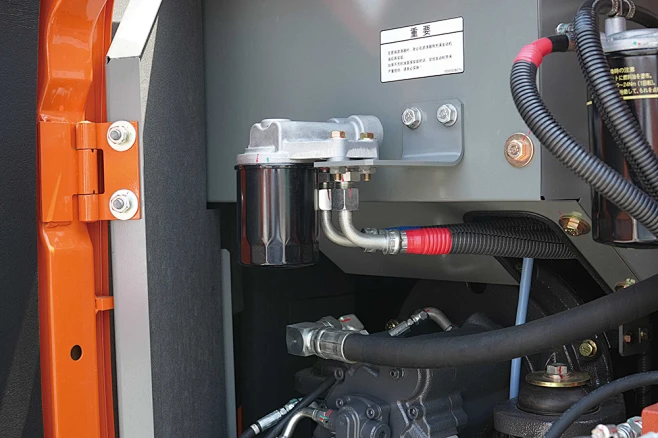
The first question in almost every enquiry is "what pressure will it hold?" Yet in the field, a burst hose is rarely the result of an undersized pressure rating. A high-pressure hydraulic hose is a composite of four layers, each with a different job: the inner tube seals and resists the fluid, the bonding layer holds the construction together, the steel wire reinforcement carries virtually all of the pressure load, and the cover simply keeps the environment out. Failures almost always follow one of three paths — outside in, inside out, or direct fatigue of the wire. Once you can read that cross-section, specification, quoting and failure analysis all become considerably easier.
1. Four layers, four different jobs
| Typical material | What it actually does | How it fails | |
|---|---|---|---|
Inner tube | Seamless extruded NBR, HNBR or FKM synthetic rubber | Seals the fluid and resists heat and chemical attack; a smooth bore limits turbulence and local erosion. It carries almost no pressure load. | Swelling, hardening and cracking, erosion from high fluid velocity, flaking debris that contaminates valves |
Bonding layer | Adhesion compound between tube and wire (present in many constructions) | Bonds rubber to steel so load transfers evenly; governs ply separation | Debonding, localised blisters, layers shifting under load |
Reinforcement | High-tensile steel wire, braided or spirally wound, one to six plies | The real pressure-containing element. Wire angle determines whether the hose grows, shortens or holds its length under pressure | Broken or corroded wires, sudden burst with the cover still intact |
Outer cover | CR or abrasion-, ozone- and weather-resistant compound; MSHA flame-resistant and ultra-wear covers available | Shields the wire from abrasion, UV, ozone, chemicals and radiant heat | Polished or worn-through cover, exposed or rusted wire, cracking, blistering |
The detail most people miss: rubber does not contain the pressure — the wire does. In classic braid theory, a "neutral angle" of roughly 54.7° to the hose axis lets the hose hold its length under pressure. In practice, ISO 18752 allows a +2% to −4% change in length at maximum working pressure. That obscure-looking figure is a direct reflection of wire angle and bond quality — and the reason hose runs need slack, but not so much that they rub against the frame.
Braid or spiral is not a question of "thicker is better"
Wire braid constructions (2SN / 100R2, R16 / R17) are flexible, tolerate a tighter bend radius and are cost-effective — well suited to medium-to-high pressure circuits with frequent movement. Spiral-wound constructions (4SP / 4SH, R13 / R15, four or six plies) deliver higher impulse life and pressure capability for mining roof supports and long-duration shock loading, at the cost of stiffness and a larger minimum bend radius. Ply count is not a pressure rating: impulse class, bend radius and weight often deserve attention before another layer of wire.
2. Three failure paths — start by looking at the cover
Classifying a failure by which layer went first narrows the investigation immediately:
| Path | Typical cause | Visible evidence | Corrective action |
|---|---|---|---|
Cover-first (outside in) | Rubbing against frames, sharp edges or adjacent hoses; UV and ozone ageing; radiant heat near exhausts | Polished or worn-through cover, exposed or rusted wire, local bulge at the contact point | Reroute and add clearance, fit abrasion sleeves or spiral guards, clamp properly, add heat shielding |
Tube-first (inside out) | Fluid incompatibility, excessive oil temperature, erosion from undersized ID, particulate contamination | Swollen or flaking tube, blistered and seeping cover, rubber debris at the fitting, discoloured fluid | Re-verify tube compound against the fluid, increase ID to reduce velocity, improve filtration, control oil temperature |
Reinforcement-first (load driven) | Pressure spikes or a failed relief valve, bend radius violation, torsional installation, impulse fatigue | Burst with the cover still intact, relatively clean wire fracture, usually near the fitting | Review relief setting and pressure cycle profile, specify a higher impulse class, restore bend radius and straight length at the ends |
A useful rule of thumb: if the cover failed first and wire is exposed, look at routing and protection. If the cover is clean and the hose still burst, look at the system — pressure spikes, impulse profile, bend radius or twist. Fitting another hose of the same specification will usually produce the same failure.
3. Six specs worth checking before "how many MPa?"
Maximum working pressure (MWP). Match it to the relief valve setting and pressure spikes, not the pump nameplate. A common engineering practice is to allow at least 1.25× the relief setting (a field rule of thumb, not a standard requirement). Machines with rapid valve shifting or frequent start-stop cycles need particular transient margin.
Minimum burst pressure. SAE J517 and ISO 18752 families generally require at least 4× MWP. It is a destructive-test safety margin — never a usable operating pressure, and never a meaningful way to compare two products.
Impulse class. ISO 18752 grades A / B / C / D are tested at 100°C or 120°C and 133% MWP for 200,000 / 500,000 / 500,000 / 1,000,000 cycles respectively (Grade C also carries a 120% condition). A hose that passes a static proof test but fails after a few months in service has usually been specified without this line item.
Minimum bend radius. Check it at the extreme of machine travel, not in the static parked position. ISO 18752 limits flattening to 10% of the original outside diameter when bent to the minimum radius (measured per ISO 10619-1). Leave a straight section at each end (a common field rule is at least 2× hose OD) and eliminate all twist — if the layline spirals around the installed hose, the assembly is twisted.
Temperature and fluid compatibility. Typical rubber hose is rated about −40°C to +100°C, with special covers reaching +120°C. Switching to phosphate ester, water-glycol, biodegradable fluid, or even a new washdown chemical means re-confirming the tube compound. ISO 1817 immersion volume change is a useful benchmark (IRM 903 oil, 100°C for 168 h: 0 to +25% for braided/textile reinforced tubes, 0 to +60% for spiral constructions).
Change in length and assembly practice. With +2% to −4% length change at MWP, a hose must never be installed dead straight — and must not be left so long that it chafes. Crimp diameter must follow the fitting manufacturer's data for that exact hose part number; "universal" crimp dimensions are a leading cause of leakage and blow-off. Insertion depth, skiving length, die set and proof-test records are all part of assembly quality.
4. A specification sheet you can send with the quote
Returning these ten items with an enquiry removes most of the back-and-forth — and is the simplest way to move from selling hose to specifying a hose assembly:
| Item | What to confirm |
|---|---|
| Fluid | Mineral oil / phosphate ester / water-glycol / biodegradable fluid; grade and actual operating temperature |
| Pressure | Steady working pressure, peak pressure, relief valve setting, frequency of pressure spikes |
| Cycling | Start-stop and valve-shift frequency per shift; continuous impulse duty or not |
| Temperature | Ambient range and any radiant heat from engines, exhausts or hot piping |
| Movement | Travel, single- or multi-plane motion, minimum bend radius at full articulation |
| Bore | Flow rate and acceptable velocity, target ID, whether fittings create a restriction |
| Construction | Braid or spiral, number of plies, compact/reduced-OD design required or not |
| End connections | JIC / ORFS / NPT / BSP / flange, crimp specification, skived or non-skived |
| Approvals | MSHA flame resistance, abrasion-resistant or low-temperature cover, customer-specific certifications |
| Traceability | Cover marking text, date code, batch identification, proof-test and crimp records |
A high-pressure hose is not merely "a rubber tube that holds pressure". It is a stack of materials with clearly divided responsibilities. Being able to explain the four layers, the three failure paths and the six parameters says more about a manufacturer's understanding of hose than one more number on a pressure chart ever will.